Showing posts with label Saints. Show all posts

Saturday, May 30, 2009

Monastic reflection

Picture from the Monastery of Philotheou on Mount Athos

"In this Jerusalem [the monastery], the Church is the center of the monk's love. The abbatial church is truly for him the building where all is sacred to God, the cherished dwelling echoing with the harmony of his praises and jubilation and proclaiming to all the fervor of his faith in the one thrice holy Lord. There, several times a day, with all the members of the cenobitcal family, the monk extends his suppliant arms, like Moses on the mountain, for the intention of his brethren fighting in the plain; he knows that he can obtain, through the ardor and constancy of his prayer, the victory for the armies of Israel over the enemies of God and of His people. Therefore his gaze, enlightened by faith, reaches out to all that touches God's Kingdom; his charity stirs up the flame of his devotion, it would reach all the souls who are struggling in ignorance, error, doubt, misery, temptation, suffering, sin; all who are spending themselves in promoting Christ's reign upon earth; all those too who are filled with the intense desire for being nearer our Lord. To render his intercession more efficacious, he joins his prayer to the all powerful and ever-answered prayer of the Divine Victim with arms stretched out upon the new Calvary which is the high altar ..."
-Blessed Dom Columba Marmion, OSB
Abbot of Maredsous Abbey in the early 20th century

(Please pray for me as I enter the monastery in early June of this year.)

RS

Saturday, May 23, 2009

Happy Feast of Saint Eutitius, Saint Spes, and Saint Florentius

"Saint Spes and Saint Eutizio with Christ"

Saint Fiorenzo of Preci

Happy feast day of the "Grandfathers" of Western Monasticism.

BTW I am referring to them in both their Italian and Latin names:

Eutizio = Eutitius (sometimes seen Eutychius, which I don't think is really correct)
Spes = Spes
Fiorenzo = Florentius

More info on them here and here.

RS

Thursday, May 14, 2009

Summaries of Plenary Indulgences for the Year of Priests

Incorrupt Body of Saint Jean Baptiste Marie Vianney

The Church has granted priests the opportunity to gain a plenary indulgence daily during the Year of Priests, and the opportunity for the laity to gain a plenary indulgence on the opening and closing days of the Year of the Priest and once a month on the first Thursdays of the month during the Year of the Priest.

For Priests:

The means to obtain the Plenary Indulgence are as follows:

(A) All truly penitent priests who, on any day, devotedly pray Lauds or Vespers before the Blessed Sacrament exposed to public adoration or in the tabernacle, and ... offer themselves with a ready and generous heart for the celebration of the Sacraments, especially the Sacrament of Penance, will be granted Plenary Indulgence, which they can also apply to their deceased confreres, if in accordance with current norms they take Sacramental Confession and the Eucharist and pray in accordance with the intentions of the Supreme Pontiff. Priests are furthermore granted Partial Indulgence, also applicable to deceased confreres, every time they devotedly recite the prayers duly approved to lead a saintly life and to carry out the duties entrusted to them.

In a simple summary, this means that priests could obtain a plenary indulgence DAILY if:

1) Each day, they devotedly pray Lauds or Vespers before the Blessed Sacrament (either exposed or in the Tabernacle)
2) Each day, they "offer themselves with a ready and generous heart for the celebration of the Sacraments (especially the Sacrament of Penance)
3) Each day, they say the usual prayers for the intentions of the Holy Father, ie one Pater Noster (Our Father) and one Ave Maria (Hail Mary)
4) Each day, they receive Holy Communion (which would naturally follow if they are offering Mass daily)
5) Go to confession at least once a week
6) Be completely detached from all sin, even venial sin. (see Fr. Tim Finigan's post on this: "Plenary Indulgences NOT Impossible")

This would be a great way to obtain great graces for the faithful departed, especially, as recommended above, for their deceased brother priests and bishops.

I would highly encourage priests to contemplate the great graces being made available to them, and to take adavantage of this opportunity to truly carry out their priestly vocation of interceding for souls and bringing them to salvation, which is the intrisic vocation of the priest.

For the laity:

The means to obtain the Plenary Indulgence are as follows:

(B) All truly penitent Christian faithful who, in church or oratory, devotedly attend Holy Mass and offer prayers to Jesus Christ, supreme and eternal Priest, for the priests of the Church, or perform any good work to sanctify and mould them to His Heart, are granted Plenary Indulgence, on the condition that they have expiated their sins through Sacramental Confession and prayed in accordance with the intentions of the Supreme Pontiff. This may be done on the opening and closing days of the Year of Priests, on the 150th anniversary of the death of St. Jean Marie Vianney, on the first Thursday of the month, or on any other day established by the ordinaries of particular places for the good of the faithful.

So in summary for the laity, on the opening day of the Year of Priests, the closing day of the Year of Priests, on the 150th Anniversary of the death of Saint John Vianney (August 4th, 2009), and on the first Thursday of each month (and other days if the local ordinary has established them):

1) Devotedly attend Mass and offer prayers to Christ the High Priest for the priests of the Church
or
perform any good work to sanctify and mould priests to the Sacred Heart of Jesus
2) Receive Holy Communion
3) Offer the usual prayers for the intentions of the Holy Father, ie one Pater Noster (Our Father) and one Ave Maria (Hail Mary)
4) Make a sacramental confession within a week of the day of seeking to obtain a plenary indulgence
5) Be completely detached from all sin, even venial sin. (see Fr. Tim Finigan's post on this: "Plenary Indulgences NOT Impossible")

This is also a great opportunity for the laity to offer these indulgences for the deceased priests of their diocese who are suffering the most in purgatory, as well as an opportunity to spiritually support the priests of their parish and diocese, those both living and deceased).

For the elderly and sick:

The elderly, the sick and all those who for any legitimate reason are unable to leave their homes, may still obtain Plenary Indulgence if, with the soul completely removed from attachment to any form of sin and with the intention of observing, as soon as they can, the usual three conditions, "on the days concerned, they pray for the sanctification of priests and offer their sickness and suffering to God through Mary, Queen of the Apostles".

So, in summary for the elderly and sick, on the opening day of the Year of Priests, the closing day of the Year of Priests, on the 150th Anniversary of the death of Saint John Vianney (August 4th, 2009), and on the first Thursday of each month (and other days if the local ordinary has established them):

1) pray for the sanctification of priests and offer their sickness and suffering to God through Mary, Queen of the Apostles"
2) Be completely detached from all sin, even venial sin. (see Fr. Tim Finigan's post on this: "Plenary Indulgences NOT Impossible")
3) Offer the usual prayers for the intentions of the Holy Father, ie one Pater Noster (Our Father) and one Ave Maria (Hail Mary)
4) If possible, receive Holy Communion, or at least have the intention to receive it as soon as possible.
5) If possible, make a sacramental confession, or at least have the intention to make it as soon as possible.

And one final reminder, even if you don't have the opportunity to obtain a plenary indulgence, you can still always obtain partial indulgences for the deceased by doing any act of devotion or prayer and offering it to God for the poor souls in Purgatory. This can be done any time and as many times as one likes. Who knows what small act may be the last thing needed to free a soul from Purgatory.

For more on partial indulgences see this link:

Partial Indulgences

Documentation for the Technical "Stuff"

“1. An indulgence is the remission in the eyes of God of the temporal punishment due to sins whose culpable element has already been taken away. The Christian faithful who are rightly disposed and observe the definite, prescribed conditions gain this remission through the effective assistance of the Church, which, as the minister of redemption, authoritatively distributes and applies the treasury of the expiatory works of Christ and the Saints.”
- Handbook of Indulgences, Norms

“23. 1. Besides the exclusion of all attachment to sin, even venial sin, the requirements for gaining a Plenary Indulgence are the performance of the indulgenced work and fulfillment of three conditions: Sacramental Confession, Eucharistic Communion, and prayer for the Pope’s intentions.
2. Several Plenary Indulgences may be gained on the basis of a single Sacramental Confession; only one may be gained, however, on the basis of a single Eucharistic Communion and prayer for the Pope’s intentions.
3. The three conditions may be carried out several days preceding or following performance of the prescribed work. But it is more fitting that the Communion and the prayer for the Pope’s intentions take place on the day the work is performed.
4. If a person is not fully disposed or if the prescribed work and the three mentioned conditions are not fulfilled, the Indulgence will only be partial ...”
5. The condition requiring prayer for the Pope’s intentions is satisfied by reciting once the Our Father and Hail Mary for his intentions (Pater Noster and Ave Maria); nevertheless all the faithful have the option of reciting any other prayer suited to their own piety and devotion.”
- Handbook of Indulgences, Norm

RS

Saturday, March 21, 2009

Happy Feast of the Transitus of Saint Benedict

Statue of Saint Benedict in the piazza in Norcia, (aka Nursia) Italy

From the Dialogues of Saint Gregory the Great, Book II:

"CHAPTER THIRTY-SEVEN: HOW VENERABLE BENEDICT DID PROPHESY TO HIS MONKS THE TIME OF HIS OWN DEATH.

In the year that was to be his last, the man of God foretold the day of his holy death to a number of his disciples. In mentioning it to some who were with him in the monastery, he bound them to strict secrecy. Some others, however, who were stationed elsewhere he only informed of the special sign they would receive at the time of his death.

Six days before he died, he gave orders for his tomb to be opened. Almost immediately he was seized with a violent fever that rapidly wasted his remaining energy. Each day his condition grew worse until finally, on the sixth day, he had his disciples carry him into the chapel where he received the Body and Blood of our Lord to gain strength for his approaching end. Then, supporting his weakend body on the arms of his brethren, he stood with his hands raised to heaven and, as he prayed, breathed his last.

That day two monks, one of them at the monastery, the other some distance away, received the very same revelation. They both saw a magnificent road covered with rich carpeting and glittering with thousands of lights. From his monastery it stretched eastward in a straight line until it reached up into heaven. And there in the brightness stood a man of majestic appearance, who asked them, "Do you know who passed this way?"

"No," they replied.

"This," he told them, "is the road taken by blessed Benedict, the Lord's beloved, when he went to heaven."

Thus, while the brethren who were with Benedict witnessed his death, those who were absent knew about it through the sign he had promised them. His body was laid to rest in the Chapel of St. John the Baptist, which he had built to replace the altar of Apollo."

RS

Friday, January 23, 2009

Comparison of Prayers - Feast of the Conversion of Saint Paul

This year, since it is in the year of Saint Paul, the Church has given permission to celebrate the Feast of the Conversion of Saint Paul on Sunday, January 25th.

The famous painting by Caravaggio of "The Conversion on the Way to Damascus" in Santa Maria del Populo, in Rome

"Conversion on the Way to Damascus" by Caravaggio

Collect (Opening Prayer)

Official Latin from the 1969 & 2002 Roman Missals
Orémus. Deus, qui univérsum mundum beáti Pauli apóstoli prædicatióne docuísti, da nobis, quaésumus, ut, cuius conversiónem hódie celebrámus, per eius ad te exémpla gradiéntes, tuæ simus mundo testes veritátis.
Per Dóminum nostrum Iesum Christum, Fílium tuum, qui tecum vivit et regnat in unitáte Spíritus Sancti, Deus, per ómnia saécula sæculórum.

Official 1973 I.C.E.L. Translation (Used at Mass in English)
Let us pray. God our Father, you taught the gospel to all the world through the preaching of Paul your apostle. May we who celebrate his conversion to the faith follow him in bearing witness to the truth.
We ask this through our Lord Jesus Christ, your Son, who lives and reigns with you and the Holy Spirit, one God, for ever and ever.

My Own Literal Translation
Let us pray. O God, You Who have taught the whole world by the preaching of the blessed Apostle Paul, grant us, we beseech You, that, as we celebrate his conversion today, while advancing to You by his example, we may be witnesses of Your truth to the world.
Through our Lord Jesus Christ, Your Son, Who lives and reigns with You, in the unity of the Holy Spirit, God, forever and ever.

"Saint Paul Preaching in Athens" by Raphael

Prayer Over the Gifts

Official Latin from the 1969 & 2002 Roman Missals
Illo nos, quaésumus, Dómine, divína tractántes, fídei lúmine Spíritus perfúndat, quo beátum Paulum apóstolum ad glóriæ tuæ propagatiónem iúgiter collustrávit.
Per Christum Dóminum nostrum.

Official 1973 I.C.E.L. Translation (Used at Mass in English)
Lord, may your Spirit who helped Paul the apostle to preach your power and glory fill us with the light of faith as we celebrate this holy eucharist.
We ask this in the name of Jesus the Lord.

My Own Literal Translation
While drawing us by this Divine Mystery, we beseech You, O Lord, may the Spirit pour forth by the light of faith, that with which he illuminated the blessed Apostle Paul for the continual spreading of Your glory.
Through Christ our Lord.

"Conversion of Saint Paul" by Rubens

Preface
Preface I of the Apostles - On the Apostles, Pastors of the People of God


Official Latin from the 1969 & 2002 Roman Missals
Vere dignum et iustum est, æquum et salútare, nos tibi semper et ubíque grátias ágere: Dómine, sancte Pater, omnípotens ætérne Deus:
Qui gregem tuum, Pastor ætérne, non déseris, sed per beátos Apóstolos contínua protectióne custódis, ut iísdem rectóribus gubernétur, quos Fílii tui vicários eídem contulísti præésse pastóres.
Et ídeo cum Angelis et Archángelis, cum Thronis et Dominatiónibus, cumque omni milítia cæléstis exércitus, hymnum glóriæ tuæ cánimus, sine fine dicéntes:
Sanctus, Sanctus, Sanctus

Official 1973 I.C.E.L. Translation (Used at Mass in English)
Father, all-powerful and ever-living God, we do well always and everywhere to give you thanks.
You are the eternal Shepherd who never leaves his flock untended. Through the apostles you watch over us and protect us always. You made them shepherds of the flock to share in the work of your Son, and from their place in heaven they guide us still.
And so, with all the choirs of angels in heaven we proclaim your glory and join in their unending hymn of praise:
Holy, holy, holy ...

My Own Literal Translation
It is truly right and just, proper and availing unto salvation, that we always and everywhere give thanks to You, O Lord, Holy Father, Almighty and Eternal God:
You, O eternal Shepherd, Who do not forsake Your flock, but keep it in Your continual protection through the blessed Apostles, so that it may be governed by those rulers, whom as the vicars of Your Son You have given to be pastors over it.
And so, with all the Angels and Archangels, with the Thrones and Dominions, with the whole army of heavenly hosts, we sing the hymn of Your glory, saying without end:
Holy, Holy, Holy ...

"The Conversion of Saint Paul" by Caravaggio

Post-Communion Prayer

Official Latin from the 1969 & 2002 Roman Missals
Orémus. Sacraménta quæ súmpsimus, Dómine Deus noster, in nobis fóveant caritátis ardórem, quo beátus apóstolus Paulus veheménter accénsus, ómnium pértulit sollicitúdinem Ecclesiárum.

Official 1973 I.C.E.L. Translation (Used at Mass in English)
Let us pray. Lord God, you filled Paul the Apostle with love for all the churches: may the sacrament we have received foster in us this love for your people.
Grant this through Christ our Lord.

My Own Literal Translation
Let us pray. O Lord our God, may the Sacraments Which we have consumed sustain in us the zeal of charity, by which the blessed Apostle Paul being ardently inflamed, bore concern for all the Church.
Through Christ our Lord.

Tomb of Saint Paul, under the main altar
at Saint Paul's Outside the Walls in Rome.

RS

Monday, December 29, 2008

Saint Thomas Becket

In honor of the feast of Saint Thomas Becket, I thought I'd post the powerful excommunication scene from the movie "Becket"


RS

Saturday, December 27, 2008

Tomb of Saint Stephen and Saint Lawrence

I know I'm a day late, but I did want to post these.

My last trip to Rome, I finally made it out to the Basilica of Saint Lawrence Outside the Walls. Father Benedict's uncle is a Deacon and he was at the ordination. So, since I wanted to go to Saint Lawrence, I was able to take the Deacon there with me. After trying to walk the distance from Termini, the main train station in Rome, and then getting lost, and then coming upon some big student protest, we decided to take a taxi the rest of the way.

We finally made it to the church.


Both Saint Stephen and Saint Lawrence are buried here.


Their tomb is under the main altar in the confessio.


If you go behind the altar and tabernacle in the confessio you can see their tomb.


RS

Thursday, December 11, 2008

Pope Saint Damasus I

Today is the feast of Pope Saint Damasus I. Although he is not very well known, he did have great influence upon the Church. He was the one who commissioned Saint Jerome to translate the Bible which resulted in the Vulgate translation of the Bible. He also decreed the canon of the New Testament, ie what books officially make up the New Testament.

He is buried in Rome in the church of San Lorenzo in Damaso. I was able to visit him my last time in Rome. It is not an easy place to find. I walked past it once before I found it. The outside isn't really that "churchy". The name of the church comes from the fact that it is believed that the pope himself founded this church on his own home and dedicated it to Saint Lawrence.


However, the inside is simple (well for a church in Rome), but beautiful. It's also nice and quiet.


He is buried under the altar here.


And when I got there, I noticed there is another Saint buried there as well.


Saint Eutychius, Martyr. Unfortunately, I can't really find any information about him. I think he is the Saint Eutychius whose feast is on February 4th.


Pope Saint Damasus I and Saint Eutychius, orate pro nobis.

RS

Saturday, December 06, 2008

Saint Leontia

Ted from Canada had emailed me asking about a Saint Leontia in my list of Saints I visted on my last pilgrimage to Rome.

What can you tell me about Saint Leontia, and is this
the individual buried in San Francesco a Ripa Church in
Trastevere, Rome?

Yes, the Saint referred to in my list is a martyr buried in San Francesco a Ripa.

Saint Leontia at San Francesco a Ripa in Rome

I honestly cannot confirm much about her. There is a Saint Leontia in the Roman Martyrology, and her feast day is today, December 6th. However, I am not sure if the Saint in the Martyrology is the same as the Saint shown above.

The entry is:

In Africa sancti Majórici, fílii sanctæ Dionysiæ, qui, cum esset adolescéntulus ac torménta pavésceret, matris obtútibus verbísque corroborátus est, et, céteris fórtior factus, in torméntis ánimam réddidit; quem amplexáta mater domi sepelívit, et ad ejus sepúlcrum assídue oráre consuévit.
Ibídem sanctárum mulíerum Dionysiæ, quæ sancti Majórici Mártyris éxstitit mater, Datívæ ac Leóntiæ; itémque religiósi viri, nómine Tértii, Æmiliáni médici, et Bonifátii, cum áliis tribus. Hi omnes, in persecutióne Wandálica, sub Ariáno Rege Hunneríco, gravíssimis et innúmeris supplíciis pro cathólicæ fídei defensióne cruciáti, sanctórum Christi Confessórum número sociári meruérunt.

In Africa, St. Majoricus, son of St. Dionysia, who, being quite young and dreading the torments, was strengthened by the looks and words of his mother, and becoming stronger than the rest, expired in torments. His mother took him in her arms, and having buried him in her own home, was wont to pray diligently at his tomb.
In the same place, the holy women Dionysia, who was the mother of St. Majoricus the martyr, Dativa, and Leontia; also a pious man named Tertius, Emilian a physician, Boniface, and three others. In the persecution of the Vandals, under the Arian king Hunneric, they were subjected to numberless most painful tortures for the Catholic faith, and thus merited to rank among the confessors of Christ.
- from breviary.net's Roman Maryrology pages
(Sorry, it's a good site for the old martyrology, but the site is run by sedevacantists).

Yet, the Saint Leontia at San Francesco a Ripa may be a little obscure Roman Martyr who, although not much was know about her life, was known to have been martyried for the faith.

The only other possible hint may be on the name plate on her tomb. It says: "CORPUS.S.LEONTIAE MART.NOM.PR."

click picture to embiggen

I'm not really sure what the "NOM.PR." part means.

So, if anyone has more information on this Saint Leontia buried in San Francesco a Ripa in Rome, I'd appreciate you letting me know. Otherwise, we'll assume this is the same Saint mentioned in the Roman Martyrology.

And also, happy feast of Saint Nicholas.

RS

Wednesday, December 03, 2008

Relic of Saint Francis Xavier


Arm of Saint Francis Xavier at Il Gesu church in Rome. This arm has Baptized and blessed thousands and thousands in India and the Orient.

The body of Saint Francis Xavier is in Goa, India.

RS

Saturday, November 29, 2008

November 29th, Feast of Saint Saturninus of Carthage

(Not to be confused with Saint Saturninus of Toulouse, Bishop & Martyr whose feast is also today)

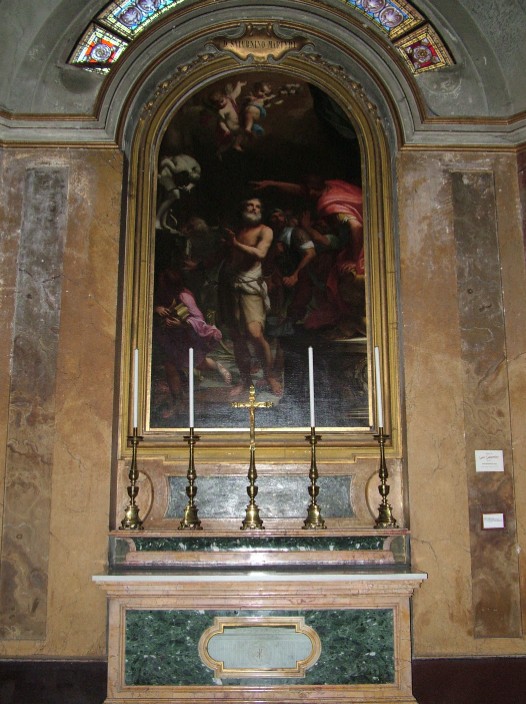
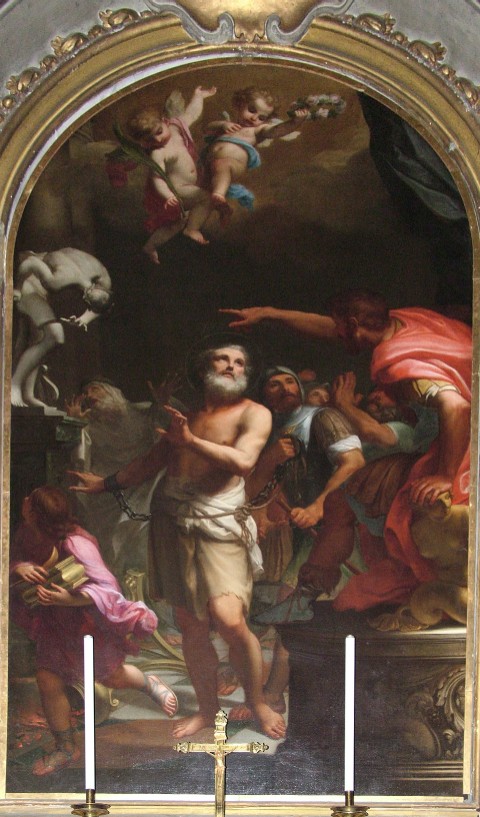
Altar and relics of Saint Saturninus of Carthage at the Basilica of Saints John and Paul in Rome

Back in 2000, I had read a story about a priest (however, it was not Saint John Marie Vianney) who had begun praying to a very obscure and unknown Saint. He reasoned that because this Saint was so unknown, she would have more "time" to pray for him and his intentions. And sure enough, intentions he had for his parish were coming to pass through the intercession of this Saint.

A few weeks after I read that story I was in Rome for the Jubilee year and my friend Father Cassian had suggested I visit the basilica of Saints John and Paul (the ones mentioned together in the Roman Canon). While I was there, I was struck by a painting and relics in a side altar of Saint Saturninus of Carthage (as seen above). And having never heard of him before, I thought about that story I had read about the priest who began praying to this obscure Saint. So, I've had a devotion to Saint Saturninus of Carthage ever since. And I was blessed to be able to visit him on my last trip to Rome back in October.

Saint Saturninus of Carthage

The new (2004) Roman Martyrology has this:

Romæ in cœmetério Trasónis via Salária Nova, sancti Saturníni Carthaginénsis, mártyris, qui, ut sanctus Dámasus papa refert, sub Décio imperatóre pro Christo in pátria in ecúleo impósitus est et Romam extórris missus, ubi, áliis atrócibus torméntis superátis, Gratiánum tyránnum ad fidem convértit et cápite obtruncáto corónam martýrii adéptus est.

My rough translation

At Rome, in the cemetary of Trasonis on the New Via Salaria, Saint Saturninus of Carthage, martyr, who, Pope Saint Damasus relates, that under the Emperor Decius, in his homeland he [St. Saturninus] was placed on the rack for Christ, and sent into exile in Rome, where, having overcome other severe tortures, converted the tyrant Gratianus to the faith, and [St. Saturninus] being beheaded obtained the crown of martyrdom.

An older version of the Roman Martyrology has this:

Romæ, via Salaria, natális sanctórum Mártyrum Saturnini senis, et Sisinii Diáconi, sub Maximiáno Príncipe; quos, diu in cárcere maceratos, jussit Urbis Præfectus in equuleum levári et attrahi nervis, fustibus ac scorpiónibus cædi, deínde eis flammas apponi, et, depositos de equuleo, cápite truncari.

At Rome, on the Salarian Way, the birthday of the holy martyr, Saturninus, an aged man, and the deacon Sisinius, in the time of Emperor Maximian. After a long imprisonment, by order of the prefect of the city they were placed on the rack, stretched with ropes, scourged with rods and whips garnished with metal, then exposed to the flames, taken down from the rack and beheaded.
- from breviary.net's Roman Maryrology pages
(Sorry, it's a good site for the old martyrology, but the site is run by sedevacantists).

I'm not sure what happened to St. Saturninus' deacon companion Sisinius in the new Martyrology. I often worry that some parts of legends are automatically thrown out if they can't be proven, rather than keeping them until the can be proven false. I feel that is often the case in the rather snotty comments in the Thurston & Atwater edition of Butler's Lives of the Saints.

A brief article at catholicculture.org had this to say:

St. Saturninus

The Martyrology gives these details: "At Rome on the Via Salaria the death of the holy martyr, the aged Saturninus, and of the deacon Sisinius. Under the emperor Maximianus they suffered long in prison. The prefect of Rome ordered them placed on the rack till their joints were torn loose, then beaten with knotted whips, and burnt with torches; at last removed from the rack, they were beheaded." According to the inscription on his tomb by Pope St. Damasus, Saturninus hailed from Carthage. The Acts of Marcellus say he was condemned as a frail old man to carry sand for the construction of the Baths of Diocletian; but when by his patience and prayer and encouragement he led many to the faith, he was beheaded.

Saint Saturninus was originally buried in the Catacombs, and Pope Saint Damasus wrote a beautiful epitaph on his tomb there:

Epigraph of Pope Saint Damasus for St. Saturninus

Citizen now of Christ, formerly of Carthage,
The moment the sword pierced the Mother's holy breast,
through her blood he changed country, name and lineage,
the birth to the life of the saints made him a Roman citizen.
His faith was wonderful: as his heroic death would later show.
His enemy Gratianus trembled while he tore his holy members;
but though all his venomous rage exploded,
he could not induce you, O Saint, to deny Christ;
indeed through your prayers he even deserved to die a Christian.
This is the will of the suppliant Damasus: venerate this tomb!
[Here it is given to fulfil vows and to pour out chaste prayers,
because it is the tomb of the martyr St Saturninus]
To you, O Martyr Saturninus, I pay my prayerful homage.

source

Here's the collect for his feast (which used to be on the universal calendar before the changes of Vatican II) from the traditional Divine Office:

Orémus.
Deus, qui nos beáti Saturníni Mártyris tui concédis natalício pérfrui: eius nos tríbue méritis adiuvári. Per Dóminum nostrum Iesum Christum, qui tecum vivit et regnat in unitáte Spíritus Sancti Deus, per ómnia saécula sæculórum. Amen.

Let us pray.
O God, Who givest us to rejoice in the feast of Thy blessed Martyr Saturninus: grant that we may be helped by his merits. Through our Lord Jesus Christ Thy Son, Who livest and reignest with Thee in the unity of the Holy Spirit, God, forever and ever. Amen.

I have become devoted to him, and love the fact that in spite of his old age he suffered for Christ, to the point of torture, exile, more torture, and martyrdom. He does show that God chooses the weak to shame the strong.

Sancte Saturníne (et Sancte Sisinie), ora(te) pro nobis.

"To you, O Martyr Saturninus, I pay my prayerful homage" as well.

And to any priests who are saying the extraordinary form of the Mass and can follow the traditional calendar or who say the ordinary form and have a copy of the Roman Martyrology, I invite you to remember him as well.

RS

Thursday, November 13, 2008

Benedictine All Saints

"The Glory of Saint Benedict" by Pietro Annigoni
at Monte Cassino

It's not my favorite picture of Saint Benedict, but it is good for today's feast, since it shows Saint Benedict in Heaven surrounded by Benedictine Saints.

Today is the Feast of All the Saints of the Benedictine Order. It's like All Saints but specifically for the Benedictine Order, thus all canonized and uncanonized Benedictines who are in Heaven are honored today. Traditionally, most of the older Orders have an All Saints and All Souls days for their Order. I know the Franciscans have their own, and I'm pretty sure the Cistercians do too.

I've never actually seen it listed in the new calendar, but it is still observed and was given a rank of a Class II feast in the old calendar (which usually translates into a Feast in the new calendar).

So, happy feast day to all my fellow Benedictines.

RS

Wednesday, November 12, 2008

Tomb of Saint Josaphat


Today is the feast of Saint Josaphat. I've had a devotion to him for awhile, and have tried to visit him every time I go to Rome. He's another Saint who is difficult to get to in Saint Peter's. His remains, as seen above, are in an altar which is in the area reserved for Confessions, and they usually won't let you in unless you are going to confession. I can usually muster up enough Italian to ask to go pray at his tomb, and they usually let me in, I think mainly because I have a beard and they think I am Eastern rite (that defintely was the case once).

On my last trip a month ago I had the great priviledge of learning how to serve the Tridentine Mass. The awesome part was that the second Tridentine Mass I helped serve was a low Tridentine Mass ... in Saint Peter's ... at the altar of Saint Josaphat. It worked out rather Providentially. Father had made arrangements to say Mass, but when we got there, they had not assigned him any altar. They just said to take any altar that was open. So after walking all around and finding every altar taken, we finally ended up at Saint Josaphat, and the priest there was just finishing up his Mass. So, I gently prodded Father in that direction, and that's where we had Mass.

I thought it was pretty appropriate that with Saint Josaphat being a Ruthenian Rite Catholic Bishop that we would say the Tridentine which is much closer to the Eastern Rites (and Tradition) than the Novus Ordo. It was also appropriate that Father Benedict being a monk would say the Mass at the relics of a Martyr who was a monk. Saint Josaphat was also a Martyr for unity between East and West in the Church, and here we had a very beautiful union of East and West and Heaven and earth. You can see the reason they put Saint Josaphat's relics in one of the altars closest to Saint Peter. Definitely a memory I will treasure.

You can read more about Saint Josaphat at Catholic Encyclopedia:

St. Josaphat Kuncevyc at Catholic Encyclopedia

RS

Monday, November 10, 2008

Tomb of Pope Saint Leo the Great

In the Ordinary Form, today is the feast of Pope Saint Leo the Great.


Here you can see where he is buried in the Basilica of Saint Peter in Vatican City. You can usually see it, but it is harder to get up to the alter itself. For some reason, that area of the basilica is usually closed off, so the closest you can get is about 30 yards away. Your best bet to visit the altar is to got to Saint Peter's right when it opens in the morning and attend one of the low private Masses at this altar. I was blessed last year with the opportunity to do this, so I snapped a couple of pictures afterwards.

So, here's just one of the many Saint's buried in Saint Peter's.

I also encourage you read Pope Saint Leo the Great's homilies. They are often very clear and solid expositions of the Faith.

You've got to love a guy who stood up to Attila the Hun.

RS

Saturday, November 08, 2008

Basilica of Saint John Lateran

A few pictures of the Basilica of Saint John Lateran.


This is the actual Cathedral of Rome and is where the cathedra of the Pope is.

Cathedra (or chair) of the Pope

The main relics in this Church are pretty important.

The main one is a part of the table from the Last Supper which is high above the Eucharistic Chapel in the left trancept.


The other major relics are up in the top of the baldachino over the papal altar.


The two statues of Saint Peter and Saint Paul hold the heads of these two Saints.

Enjoy.

RS

Wednesday, October 22, 2008

Saints Galore

No, it's not just the name of my friends Catholic gretting card and calendar company. It's also a description of my last 30 hours.

I did manage to get into Saint Peters, so I was able to visit almost every Saint I wanted to (I only missed Saint Petronella), and I didn't get down into the crypt.

Today, I was all over the place. I think so far my total of Saints over the last 30 hours is around 40. However, I really did try to make my visits as reverent and recollected as possible. As Saint Benedict says, you don't have to sit and multiply your words in your prayers like the pagans do. The only Saint I haven't been able to see so far is Saint Agnes because the relic chapel is under repair, so it was totally closed off.

I'll try to get the list of Saints up when I get home.

Ciao for now.

RS

Thursday, September 18, 2008

Saint Joseph of Cupertino

Saint Joseph of Cupertino

Today is the feast day of Saint Joseph of Cupertino. I thought I would share a few pictures from Assisi. Last year at this time I was making pilgrimage to Italy. A year ago tomorrow, I was in Assisi. I found a friar there whom I had met back in 2002. He was gracious enough to "sneak" me into the cell ... or actually prison cell" where Saint Joseph of Cupertino was held during the time the friars thought he might be possessed because sometime he would levitate. So, I thank Fr. Alfeo for allowing me to see the cell.
One reason I had asked him and knew about the cell before was that I was able to see it back during my Rome semester in 1993. At that time it was pretty unkept and sadly looked like it had been used as a storage closet. But last year I figured since it was the day after Saint Joseph of Cupertino's feast day, and since I had a friend who had just joined the Franciscans of the Immaculate who had a great devotion to Saint Joseph of Cupertino, I thought I'd try to get in and say some prayers for him (and take a few photos).

Sorry these are a bit lower in quality.

Part of the "prison" cell where Saint Joseph of Cupertino was held

Where Saint Joseph of Cupertino prayed (same room as the picture above)

Habit of Saint Joseph of Cupertino above the altar where he said Mass while imprisoned
(in a separate room right behind me when I took the first two pictures)

Chapel dedicated to Saint Joseph of Cupertino
(his cell is on the other side of the painting)

Life of Saint Joseph of Cupertino on EWTN

Thanks again to Father Alfeo.

RS

Wednesday, September 03, 2008

Tomb of Saint Gregory the Great

Here's a few new photos which I took on my pilgrimage a year ago. Pope Saint Gregory the Great holds a place in my heart, not just because I am a Benedictine Novice Oblate and he was a Benedictine monk, but also because of the Masses I have heard at his altar in Saint Peter's. Pope Saint Gregory the Great's relics are in an altar very near the sacristy of Saint Peter's.

An interesting thing, if you ever visit Rome, is that if you can go to Saint Peter's right when the doors open in the early morning, you can attend a Mass of any number of the priests who say Mass at any of the side altars. What is nice about these Masses is that they are practically a private Mass. Usually, it is just the priest and the altar boy, however, the altar boy will sort of ask you if you are going to receive Communion [quizzical looks and a nodding of the head work well in spite of the language barrier, LOL], and give the priest an extra host at the offertory if you are. Anyway, the Mass, although a simple, low Novus Ordo Mass, is very beautiful and reverent if you get a good priest (as I did).

Since I had a devotion to Pope Saint Gregory the Great, I made it a point everyday I was in Rome, to get up early and go to the Mass at his altar.


Providentially, the priest who regularly said Mass at that altar spoke English. But it gets even better. Usually, the the priests say Mass in Italian. However, the second day I went, when the priest came to the altar and saw me again, he went up to the altar, took the Italian Missal, went over to the little cabinet next to the altar, put the Italian Missal in, and pulled a Latin Roman Missal out!


At that point, I was on a spiritual high. And the rest of my pilgrimage he used the Latin Roman Missal when he saw me. I made it a point to thank him, and he told me that since I was obviously not Italian, he figured I would have an easier time with the Latin. Indeed it was true. Being obedient to Vatican II, I know in Latin the parts of the Mass which pertain to me.*

I also love Pope Saint Gregory the Great because of his "Dialogues" which is the best source of information on the life of Saint Benedict, and which gave me information about some other Saints whom I love, Sant'Eutizio, San Fiorenzo, and San Spes.

His name is also attached to the chant of the Roman Rite (Gregorian Chant).


Sancte Gregori, ora pro nobis.

*Sacrosanctum Concilium
"36. 1. Particular law remaining in force, the use of the Latin language is to be preserved in the Latin rites."
"54. "... steps should be taken so that the faithful may also be able to say or to sing together in Latin those parts of the Ordinary of the Mass which pertain to them. "

RS

Thursday, August 14, 2008

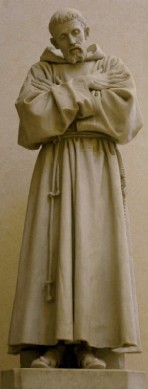
Saint Maximilian Kolbe

Saint Maximilian Kolbe, OFMConv.

When I look at him and his life, I feel like the Don Quixote of the Knights of the Immaculata.

RS

Friday, July 25, 2008

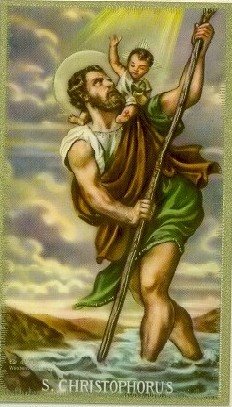
Happy Feast of Saint Christopher


OK, liturgically it's only a commemoration, but Saint Christopher is still a Saint in the eyes of the Church, no matter what some might tell you. Even if his Martyrology entry has been shortened to:

"2. In Lycia, sancti Christophori, martyris."
"2. In Lycia, Saint Christopher, Martyr."

"Saint Christopher" by Albrecht Durer

From a more lengthy haegiography:

"An ancient tradition concerning St. Christophorus relates: He was born in the land of Canaan, and was named Reprobus, that is Reprobate, for he was a barbarous heathen. In stature and strength he was a giant. Thinking no one his like in bodily vigor, he resolved to go forth in search of the mightiest master and serve him. In his wanderings, he met with a king who was praised as the most valorous man on earth. To him he offered his services and was accepted. The king was proud of his giant and kept him near his person. One day a minstrel visited the king's castle, and among the ballads he sung before the court was one on the power of Satan. At the mention of this name the king blessed himself, making the Sign of the Cross. Reprobus, wondering, asked him why he did that. The king replied: "When I make the sign, Satan has no power over me." Christophorus rejoined: "So thou fearest the power of Satan? Then he is mightier than thou, and I shall set and serve him."
Setting forth to seek Satan, he came into the wilderness. One dark night he met a band of wild fellows riding through the forest. It was Satan and his escort. Christophorus bravely accosted him, saying he wished to serve him. He was accepted. But soon he was convinced that his new master was not the mightiest on earth. For, one day, whilst approaching a crucifix by the wayside, Satan quickly took to flight, and the Saint asked him for the reason. Satan replied "That is the image of my greatest enemy, Who conquered me on the Cross. From Him I always flee." When Saint Christopher heard this, he left the devil, and went in search of Christ."

"Saint Christopher" by Dieric Bouts the Younger

"In his wanderings, he one day came to a hut hidden in the forest. At its door sat a venerable old man. The Saint addressed him, and in the course of the conversation that ensued the old man told him that he was a hermit, and had left the world to serve Christ, the Lord of Heaven and earth.
"Thou art my man," cried the Saint! "Christ is He Whom I seek, for He is the strongest and the mightiest. Tell me where I can find Him."
The hermit then began instructing the giant about God and the Redeemer, and concluded by saying: "He who would serve Christ must offer himself entirely to Him, and do and suffer everything for His sake. His reward for this will be immense and will last forever." Christophorus now asked the hermit to allow him to remain, and to continue to instruct him. The hermit consented. When he was fully instructed, the hermit Baptized him. After his Baptism, a great change came over the giant. No longer proud of his great size and strength, he became meek and humble, and asked the hermit to assign to him some task by which he might serve God, his master. "For," said he, "I can not pray and fast; therefore I must serve God in some other way."

"Saint Christopher" by Jusepe de Ribera

"The hermit led him to a broad and swift river nearby, and said: "Here build thyself a hut, and when wanderers wish to cross the river, carry them over for the love of Christ." For there was no bridge across the river. Henceforth, day and night, whenever he was called, Reprobus faithfully performed the task assigned to him. One night he heard a child calling to be carried across the river. Quickly he rose, placed the child on his stout shoulder, took his staff and walked into the mighty current.
Arrived in midstream, the water rose higher and higher, and the child became heavier and heavier. "O child," he cried, "how heavy thou art! It seems I bear the weight of the world on my shoulder." And the child replied, "Right thou art. Thou bearest not only the world, but the Creator of Heaven and earth. I am Jesus Christ, thy King and Lord, and henceforth thou shalt be called Christophorus, that is, Christ-bearer. Arrived on yonder shore, plant thy staff in the ground, and in token of My power and might tomorrow it shall bear leaves and blossoms."

"Saint Christopher" by Orazio Borgianni

"And the child disappeared. On reaching the other shore, Christophorus stuck his staff into the ground, and behold, it budded forth leaves and blossoms. Then, kneeling, he promised the Lord to serve Him ever faithfully. He kept his promise, and thenceforth became a zealous preacher of the Gospel, converting many to the Faith. On his missionary peregrinations he came also to Lycia, where, after his first sermon, eighteen thousand heathens requested Baptism.
When Emperor Decius heard of this, he sent a company of four hundred soldiers to capture Christophorus. To these he preached so convincingly, that they all asked for Baptism. Decius became enraged thereat and had him cast into prison. There he first treated him with great kindness, and surrounded him with every luxury to tempt him to sin, but in vain. Then he ordered him to be tortured in the most cruel manner, until he should deny the Faith. He was scourged, placed on plates of hot iron, boiling oil was poured over and fire was lighted under him. When all these torments did not accomplish their purpose, the soldiers were ordered to shoot him with arrows. This, too, having no effect, he was beheaded, on July 25, 254."

"Saint Christopher" by Peter Paul Rubens

"Two great Saints refer to the wonderful achievements of St. Christophorus. St. Ambrose mentions that this Saint converted forty-eight thousand souls to Christ. St. Vincent Ferrer declares that when the plague devastated Valencia, its destructive course was stayed through the intercession of St. Christophorus."

"Saint Christopher" by Titian


RS