



Aw geeze! I just saw the trailer for "Angels and Demons" by Dan Brown. I'm honestly astonished that it appears to be even more anti-Catholic than "The DaVinci Code" was. You hear the words "the truth" thrown around in the trailer alot, which is so ironic given the flimsy plots of all of Dan Brown's books.
It looks like it will present itself as some sort of heroic movie pushing the question of science versus religion driving the two things into a strict either/or situation rather than seeing their compatibility.
The plot of the story is just completely absurd. The whole irony is that people will get pulled into the whole "religion versus science" debate and have doubts about religion, yet will fail to miss all the poor science and non sequitur moments in the actual plot of the book.
This will be the new controversial film of the year because you can tell the studio is going to hype this with all the advertising they can. Of course the other irony is that the movie will try to tell people not to have blind faith regarding religion, but obviously if they are going to see the movie, they will have proven that they have blind faith about the advertising. Sadly, this film will be a blockbuster, mainly because of the advertising, not because of the content. Don't believe me, just look at what happened with "The DaVinci Code." The media and controversy surrounding it made it a blockbuster, but the critics and most moviegoers said the movie was lame. I'm sure this time the studios have hired actual writers to clean the script up. And people say that those who follow religion are just dumb sheep. Ugh.
I would say that this is the perfect time for the Church to emphasize more the compatibility of scienc and religion, as it always has.
For instance, do you know where the theory of the Big Bang came from? A Catholic priest named Georges Lemaitre.
Hopefully Amy Welborn is writing a new book as we speak. LOL.
RS
Showing posts with label Rome. Show all posts
Showing posts with label Rome. Show all posts
Tuesday, April 28, 2009

Friday, January 23, 2009
Comparison of Prayers - Feast of the Conversion of Saint Paul
This year, since it is in the year of Saint Paul, the Church has given permission to celebrate the Feast of the Conversion of Saint Paul on Sunday, January 25th.

The famous painting by Caravaggio of "The Conversion on the Way to Damascus" in Santa Maria del Populo, in Rome

"Conversion on the Way to Damascus" by Caravaggio
Collect (Opening Prayer)
Official Latin from the 1969 & 2002 Roman Missals
Orémus. Deus, qui univérsum mundum beáti Pauli apóstoli prædicatióne docuísti, da nobis, quaésumus, ut, cuius conversiónem hódie celebrámus, per eius ad te exémpla gradiéntes, tuæ simus mundo testes veritátis.
Per Dóminum nostrum Iesum Christum, Fílium tuum, qui tecum vivit et regnat in unitáte Spíritus Sancti, Deus, per ómnia saécula sæculórum.
Official 1973 I.C.E.L. Translation (Used at Mass in English)
Let us pray. God our Father, you taught the gospel to all the world through the preaching of Paul your apostle. May we who celebrate his conversion to the faith follow him in bearing witness to the truth.
We ask this through our Lord Jesus Christ, your Son, who lives and reigns with you and the Holy Spirit, one God, for ever and ever.
My Own Literal Translation
Let us pray. O God, You Who have taught the whole world by the preaching of the blessed Apostle Paul, grant us, we beseech You, that, as we celebrate his conversion today, while advancing to You by his example, we may be witnesses of Your truth to the world.
Through our Lord Jesus Christ, Your Son, Who lives and reigns with You, in the unity of the Holy Spirit, God, forever and ever.

"Saint Paul Preaching in Athens" by Raphael
Prayer Over the Gifts
Official Latin from the 1969 & 2002 Roman Missals
Illo nos, quaésumus, Dómine, divína tractántes, fídei lúmine Spíritus perfúndat, quo beátum Paulum apóstolum ad glóriæ tuæ propagatiónem iúgiter collustrávit.
Per Christum Dóminum nostrum.
Official 1973 I.C.E.L. Translation (Used at Mass in English)
Lord, may your Spirit who helped Paul the apostle to preach your power and glory fill us with the light of faith as we celebrate this holy eucharist.
We ask this in the name of Jesus the Lord.
My Own Literal Translation
While drawing us by this Divine Mystery, we beseech You, O Lord, may the Spirit pour forth by the light of faith, that with which he illuminated the blessed Apostle Paul for the continual spreading of Your glory.
Through Christ our Lord.

"Conversion of Saint Paul" by Rubens
Preface
Preface I of the Apostles - On the Apostles, Pastors of the People of God
Official Latin from the 1969 & 2002 Roman Missals
Vere dignum et iustum est, æquum et salútare, nos tibi semper et ubíque grátias ágere: Dómine, sancte Pater, omnípotens ætérne Deus:
Qui gregem tuum, Pastor ætérne, non déseris, sed per beátos Apóstolos contínua protectióne custódis, ut iísdem rectóribus gubernétur, quos Fílii tui vicários eídem contulísti præésse pastóres.
Et ídeo cum Angelis et Archángelis, cum Thronis et Dominatiónibus, cumque omni milítia cæléstis exércitus, hymnum glóriæ tuæ cánimus, sine fine dicéntes:
Sanctus, Sanctus, Sanctus
Official 1973 I.C.E.L. Translation (Used at Mass in English)
Father, all-powerful and ever-living God, we do well always and everywhere to give you thanks.
You are the eternal Shepherd who never leaves his flock untended. Through the apostles you watch over us and protect us always. You made them shepherds of the flock to share in the work of your Son, and from their place in heaven they guide us still.
And so, with all the choirs of angels in heaven we proclaim your glory and join in their unending hymn of praise:
Holy, holy, holy ...
My Own Literal Translation
It is truly right and just, proper and availing unto salvation, that we always and everywhere give thanks to You, O Lord, Holy Father, Almighty and Eternal God:
You, O eternal Shepherd, Who do not forsake Your flock, but keep it in Your continual protection through the blessed Apostles, so that it may be governed by those rulers, whom as the vicars of Your Son You have given to be pastors over it.
And so, with all the Angels and Archangels, with the Thrones and Dominions, with the whole army of heavenly hosts, we sing the hymn of Your glory, saying without end:
Holy, Holy, Holy ...

"The Conversion of Saint Paul" by Caravaggio
Post-Communion Prayer
Official Latin from the 1969 & 2002 Roman Missals
Orémus. Sacraménta quæ súmpsimus, Dómine Deus noster, in nobis fóveant caritátis ardórem, quo beátus apóstolus Paulus veheménter accénsus, ómnium pértulit sollicitúdinem Ecclesiárum.
Official 1973 I.C.E.L. Translation (Used at Mass in English)
Let us pray. Lord God, you filled Paul the Apostle with love for all the churches: may the sacrament we have received foster in us this love for your people.
Grant this through Christ our Lord.
My Own Literal Translation
Let us pray. O Lord our God, may the Sacraments Which we have consumed sustain in us the zeal of charity, by which the blessed Apostle Paul being ardently inflamed, bore concern for all the Church.
Through Christ our Lord.

Tomb of Saint Paul, under the main altar
at Saint Paul's Outside the Walls in Rome.
RS


Collect (Opening Prayer)
Official Latin from the 1969 & 2002 Roman Missals
Orémus. Deus, qui univérsum mundum beáti Pauli apóstoli prædicatióne docuísti, da nobis, quaésumus, ut, cuius conversiónem hódie celebrámus, per eius ad te exémpla gradiéntes, tuæ simus mundo testes veritátis.
Per Dóminum nostrum Iesum Christum, Fílium tuum, qui tecum vivit et regnat in unitáte Spíritus Sancti, Deus, per ómnia saécula sæculórum.
Official 1973 I.C.E.L. Translation (Used at Mass in English)
Let us pray. God our Father, you taught the gospel to all the world through the preaching of Paul your apostle. May we who celebrate his conversion to the faith follow him in bearing witness to the truth.
We ask this through our Lord Jesus Christ, your Son, who lives and reigns with you and the Holy Spirit, one God, for ever and ever.
My Own Literal Translation
Let us pray. O God, You Who have taught the whole world by the preaching of the blessed Apostle Paul, grant us, we beseech You, that, as we celebrate his conversion today, while advancing to You by his example, we may be witnesses of Your truth to the world.
Through our Lord Jesus Christ, Your Son, Who lives and reigns with You, in the unity of the Holy Spirit, God, forever and ever.

Prayer Over the Gifts
Official Latin from the 1969 & 2002 Roman Missals
Illo nos, quaésumus, Dómine, divína tractántes, fídei lúmine Spíritus perfúndat, quo beátum Paulum apóstolum ad glóriæ tuæ propagatiónem iúgiter collustrávit.
Per Christum Dóminum nostrum.
Official 1973 I.C.E.L. Translation (Used at Mass in English)
Lord, may your Spirit who helped Paul the apostle to preach your power and glory fill us with the light of faith as we celebrate this holy eucharist.
We ask this in the name of Jesus the Lord.
My Own Literal Translation
While drawing us by this Divine Mystery, we beseech You, O Lord, may the Spirit pour forth by the light of faith, that with which he illuminated the blessed Apostle Paul for the continual spreading of Your glory.
Through Christ our Lord.

Preface
Preface I of the Apostles - On the Apostles, Pastors of the People of God
Official Latin from the 1969 & 2002 Roman Missals
Vere dignum et iustum est, æquum et salútare, nos tibi semper et ubíque grátias ágere: Dómine, sancte Pater, omnípotens ætérne Deus:
Qui gregem tuum, Pastor ætérne, non déseris, sed per beátos Apóstolos contínua protectióne custódis, ut iísdem rectóribus gubernétur, quos Fílii tui vicários eídem contulísti præésse pastóres.
Et ídeo cum Angelis et Archángelis, cum Thronis et Dominatiónibus, cumque omni milítia cæléstis exércitus, hymnum glóriæ tuæ cánimus, sine fine dicéntes:
Sanctus, Sanctus, Sanctus
Official 1973 I.C.E.L. Translation (Used at Mass in English)
Father, all-powerful and ever-living God, we do well always and everywhere to give you thanks.
You are the eternal Shepherd who never leaves his flock untended. Through the apostles you watch over us and protect us always. You made them shepherds of the flock to share in the work of your Son, and from their place in heaven they guide us still.
And so, with all the choirs of angels in heaven we proclaim your glory and join in their unending hymn of praise:
Holy, holy, holy ...
My Own Literal Translation
It is truly right and just, proper and availing unto salvation, that we always and everywhere give thanks to You, O Lord, Holy Father, Almighty and Eternal God:
You, O eternal Shepherd, Who do not forsake Your flock, but keep it in Your continual protection through the blessed Apostles, so that it may be governed by those rulers, whom as the vicars of Your Son You have given to be pastors over it.
And so, with all the Angels and Archangels, with the Thrones and Dominions, with the whole army of heavenly hosts, we sing the hymn of Your glory, saying without end:
Holy, Holy, Holy ...

Post-Communion Prayer
Official Latin from the 1969 & 2002 Roman Missals
Orémus. Sacraménta quæ súmpsimus, Dómine Deus noster, in nobis fóveant caritátis ardórem, quo beátus apóstolus Paulus veheménter accénsus, ómnium pértulit sollicitúdinem Ecclesiárum.
Official 1973 I.C.E.L. Translation (Used at Mass in English)
Let us pray. Lord God, you filled Paul the Apostle with love for all the churches: may the sacrament we have received foster in us this love for your people.
Grant this through Christ our Lord.
My Own Literal Translation
Let us pray. O Lord our God, may the Sacraments Which we have consumed sustain in us the zeal of charity, by which the blessed Apostle Paul being ardently inflamed, bore concern for all the Church.
Through Christ our Lord.

at Saint Paul's Outside the Walls in Rome.
RS
Saturday, December 27, 2008
Tomb of Saint Stephen and Saint Lawrence
I know I'm a day late, but I did want to post these.
My last trip to Rome, I finally made it out to the Basilica of Saint Lawrence Outside the Walls. Father Benedict's uncle is a Deacon and he was at the ordination. So, since I wanted to go to Saint Lawrence, I was able to take the Deacon there with me. After trying to walk the distance from Termini, the main train station in Rome, and then getting lost, and then coming upon some big student protest, we decided to take a taxi the rest of the way.
We finally made it to the church.

Both Saint Stephen and Saint Lawrence are buried here.


Their tomb is under the main altar in the confessio.


If you go behind the altar and tabernacle in the confessio you can see their tomb.

RS
My last trip to Rome, I finally made it out to the Basilica of Saint Lawrence Outside the Walls. Father Benedict's uncle is a Deacon and he was at the ordination. So, since I wanted to go to Saint Lawrence, I was able to take the Deacon there with me. After trying to walk the distance from Termini, the main train station in Rome, and then getting lost, and then coming upon some big student protest, we decided to take a taxi the rest of the way.
We finally made it to the church.

Both Saint Stephen and Saint Lawrence are buried here.


Their tomb is under the main altar in the confessio.


If you go behind the altar and tabernacle in the confessio you can see their tomb.

RS
Thursday, December 11, 2008
Pope Saint Damasus I
Today is the feast of Pope Saint Damasus I. Although he is not very well known, he did have great influence upon the Church. He was the one who commissioned Saint Jerome to translate the Bible which resulted in the Vulgate translation of the Bible. He also decreed the canon of the New Testament, ie what books officially make up the New Testament.
He is buried in Rome in the church of San Lorenzo in Damaso. I was able to visit him my last time in Rome. It is not an easy place to find. I walked past it once before I found it. The outside isn't really that "churchy". The name of the church comes from the fact that it is believed that the pope himself founded this church on his own home and dedicated it to Saint Lawrence.

However, the inside is simple (well for a church in Rome), but beautiful. It's also nice and quiet.

He is buried under the altar here.

And when I got there, I noticed there is another Saint buried there as well.

Saint Eutychius, Martyr. Unfortunately, I can't really find any information about him. I think he is the Saint Eutychius whose feast is on February 4th.

Pope Saint Damasus I and Saint Eutychius, orate pro nobis.
RS
He is buried in Rome in the church of San Lorenzo in Damaso. I was able to visit him my last time in Rome. It is not an easy place to find. I walked past it once before I found it. The outside isn't really that "churchy". The name of the church comes from the fact that it is believed that the pope himself founded this church on his own home and dedicated it to Saint Lawrence.

However, the inside is simple (well for a church in Rome), but beautiful. It's also nice and quiet.

He is buried under the altar here.

And when I got there, I noticed there is another Saint buried there as well.

Saint Eutychius, Martyr. Unfortunately, I can't really find any information about him. I think he is the Saint Eutychius whose feast is on February 4th.

Pope Saint Damasus I and Saint Eutychius, orate pro nobis.
RS
Saturday, December 06, 2008
Saint Leontia
Ted from Canada had emailed me asking about a Saint Leontia in my list of Saints I visted on my last pilgrimage to Rome.
Yes, the Saint referred to in my list is a martyr buried in San Francesco a Ripa.

Saint Leontia at San Francesco a Ripa in Rome
I honestly cannot confirm much about her. There is a Saint Leontia in the Roman Martyrology, and her feast day is today, December 6th. However, I am not sure if the Saint in the Martyrology is the same as the Saint shown above.
The entry is:
(Sorry, it's a good site for the old martyrology, but the site is run by sedevacantists).
Yet, the Saint Leontia at San Francesco a Ripa may be a little obscure Roman Martyr who, although not much was know about her life, was known to have been martyried for the faith.
The only other possible hint may be on the name plate on her tomb. It says: "CORPUS.S.LEONTIAE MART.NOM.PR."

click picture to embiggen
I'm not really sure what the "NOM.PR." part means.
So, if anyone has more information on this Saint Leontia buried in San Francesco a Ripa in Rome, I'd appreciate you letting me know. Otherwise, we'll assume this is the same Saint mentioned in the Roman Martyrology.
And also, happy feast of Saint Nicholas.
RS
What can you tell me about Saint Leontia, and is this
the individual buried in San Francesco a Ripa Church in
Trastevere, Rome?
Yes, the Saint referred to in my list is a martyr buried in San Francesco a Ripa.

I honestly cannot confirm much about her. There is a Saint Leontia in the Roman Martyrology, and her feast day is today, December 6th. However, I am not sure if the Saint in the Martyrology is the same as the Saint shown above.
The entry is:
In Africa sancti Majórici, fílii sanctæ Dionysiæ, qui, cum esset adolescéntulus ac torménta pavésceret, matris obtútibus verbísque corroborátus est, et, céteris fórtior factus, in torméntis ánimam réddidit; quem amplexáta mater domi sepelívit, et ad ejus sepúlcrum assídue oráre consuévit.- from breviary.net's Roman Maryrology pages
Ibídem sanctárum mulíerum Dionysiæ, quæ sancti Majórici Mártyris éxstitit mater, Datívæ ac Leóntiæ; itémque religiósi viri, nómine Tértii, Æmiliáni médici, et Bonifátii, cum áliis tribus. Hi omnes, in persecutióne Wandálica, sub Ariáno Rege Hunneríco, gravíssimis et innúmeris supplíciis pro cathólicæ fídei defensióne cruciáti, sanctórum Christi Confessórum número sociári meruérunt.
In Africa, St. Majoricus, son of St. Dionysia, who, being quite young and dreading the torments, was strengthened by the looks and words of his mother, and becoming stronger than the rest, expired in torments. His mother took him in her arms, and having buried him in her own home, was wont to pray diligently at his tomb.
In the same place, the holy women Dionysia, who was the mother of St. Majoricus the martyr, Dativa, and Leontia; also a pious man named Tertius, Emilian a physician, Boniface, and three others. In the persecution of the Vandals, under the Arian king Hunneric, they were subjected to numberless most painful tortures for the Catholic faith, and thus merited to rank among the confessors of Christ.
(Sorry, it's a good site for the old martyrology, but the site is run by sedevacantists).
Yet, the Saint Leontia at San Francesco a Ripa may be a little obscure Roman Martyr who, although not much was know about her life, was known to have been martyried for the faith.
The only other possible hint may be on the name plate on her tomb. It says: "CORPUS.S.LEONTIAE MART.NOM.PR."

I'm not really sure what the "NOM.PR." part means.
So, if anyone has more information on this Saint Leontia buried in San Francesco a Ripa in Rome, I'd appreciate you letting me know. Otherwise, we'll assume this is the same Saint mentioned in the Roman Martyrology.
And also, happy feast of Saint Nicholas.
RS
Wednesday, December 03, 2008
Relic of Saint Francis Xavier

Arm of Saint Francis Xavier at Il Gesu church in Rome. This arm has Baptized and blessed thousands and thousands in India and the Orient.
The body of Saint Francis Xavier is in Goa, India.
RS
Saturday, November 29, 2008
November 29th, Feast of Saint Saturninus of Carthage
(Not to be confused with Saint Saturninus of Toulouse, Bishop & Martyr whose feast is also today)
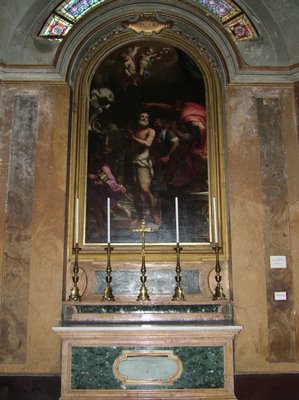
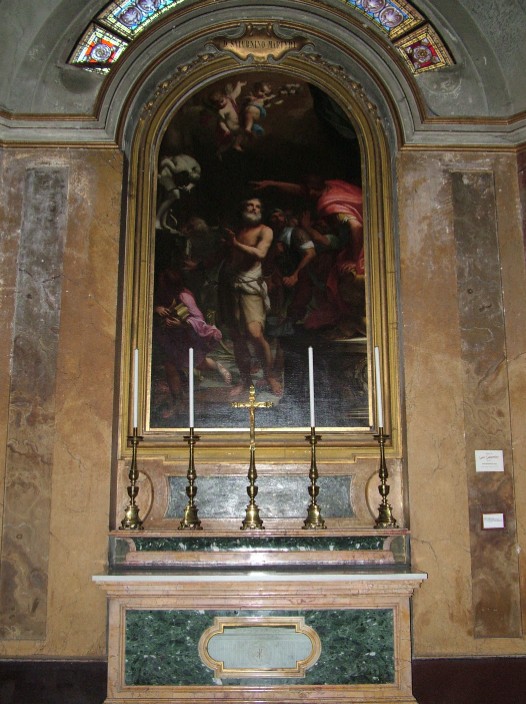
Altar and relics of Saint Saturninus of Carthage at the Basilica of Saints John and Paul in Rome
Back in 2000, I had read a story about a priest (however, it was not Saint John Marie Vianney) who had begun praying to a very obscure and unknown Saint. He reasoned that because this Saint was so unknown, she would have more "time" to pray for him and his intentions. And sure enough, intentions he had for his parish were coming to pass through the intercession of this Saint.
A few weeks after I read that story I was in Rome for the Jubilee year and my friend Father Cassian had suggested I visit the basilica of Saints John and Paul (the ones mentioned together in the Roman Canon). While I was there, I was struck by a painting and relics in a side altar of Saint Saturninus of Carthage (as seen above). And having never heard of him before, I thought about that story I had read about the priest who began praying to this obscure Saint. So, I've had a devotion to Saint Saturninus of Carthage ever since. And I was blessed to be able to visit him on my last trip to Rome back in October.

Saint Saturninus of Carthage
The new (2004) Roman Martyrology has this:
My rough translation
An older version of the Roman Martyrology has this:
(Sorry, it's a good site for the old martyrology, but the site is run by sedevacantists).
I'm not sure what happened to St. Saturninus' deacon companion Sisinius in the new Martyrology. I often worry that some parts of legends are automatically thrown out if they can't be proven, rather than keeping them until the can be proven false. I feel that is often the case in the rather snotty comments in the Thurston & Atwater edition of Butler's Lives of the Saints.
A brief article at catholicculture.org had this to say:
Saint Saturninus was originally buried in the Catacombs, and Pope Saint Damasus wrote a beautiful epitaph on his tomb there:
Epigraph of Pope Saint Damasus for St. Saturninus
source
Here's the collect for his feast (which used to be on the universal calendar before the changes of Vatican II) from the traditional Divine Office:
I have become devoted to him, and love the fact that in spite of his old age he suffered for Christ, to the point of torture, exile, more torture, and martyrdom. He does show that God chooses the weak to shame the strong.
Sancte Saturníne (et Sancte Sisinie), ora(te) pro nobis.
"To you, O Martyr Saturninus, I pay my prayerful homage" as well.
And to any priests who are saying the extraordinary form of the Mass and can follow the traditional calendar or who say the ordinary form and have a copy of the Roman Martyrology, I invite you to remember him as well.
RS
Back in 2000, I had read a story about a priest (however, it was not Saint John Marie Vianney) who had begun praying to a very obscure and unknown Saint. He reasoned that because this Saint was so unknown, she would have more "time" to pray for him and his intentions. And sure enough, intentions he had for his parish were coming to pass through the intercession of this Saint.
A few weeks after I read that story I was in Rome for the Jubilee year and my friend Father Cassian had suggested I visit the basilica of Saints John and Paul (the ones mentioned together in the Roman Canon). While I was there, I was struck by a painting and relics in a side altar of Saint Saturninus of Carthage (as seen above). And having never heard of him before, I thought about that story I had read about the priest who began praying to this obscure Saint. So, I've had a devotion to Saint Saturninus of Carthage ever since. And I was blessed to be able to visit him on my last trip to Rome back in October.
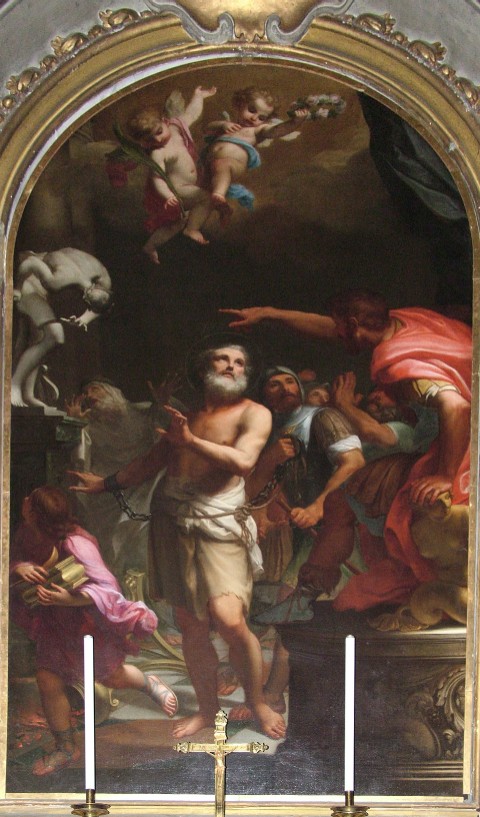
The new (2004) Roman Martyrology has this:
Romæ in cœmetério Trasónis via Salária Nova, sancti Saturníni Carthaginénsis, mártyris, qui, ut sanctus Dámasus papa refert, sub Décio imperatóre pro Christo in pátria in ecúleo impósitus est et Romam extórris missus, ubi, áliis atrócibus torméntis superátis, Gratiánum tyránnum ad fidem convértit et cápite obtruncáto corónam martýrii adéptus est.
My rough translation
At Rome, in the cemetary of Trasonis on the New Via Salaria, Saint Saturninus of Carthage, martyr, who, Pope Saint Damasus relates, that under the Emperor Decius, in his homeland he [St. Saturninus] was placed on the rack for Christ, and sent into exile in Rome, where, having overcome other severe tortures, converted the tyrant Gratianus to the faith, and [St. Saturninus] being beheaded obtained the crown of martyrdom.
An older version of the Roman Martyrology has this:
Romæ, via Salaria, natális sanctórum Mártyrum Saturnini senis, et Sisinii Diáconi, sub Maximiáno Príncipe; quos, diu in cárcere maceratos, jussit Urbis Præfectus in equuleum levári et attrahi nervis, fustibus ac scorpiónibus cædi, deínde eis flammas apponi, et, depositos de equuleo, cápite truncari.- from breviary.net's Roman Maryrology pages
At Rome, on the Salarian Way, the birthday of the holy martyr, Saturninus, an aged man, and the deacon Sisinius, in the time of Emperor Maximian. After a long imprisonment, by order of the prefect of the city they were placed on the rack, stretched with ropes, scourged with rods and whips garnished with metal, then exposed to the flames, taken down from the rack and beheaded.
(Sorry, it's a good site for the old martyrology, but the site is run by sedevacantists).
I'm not sure what happened to St. Saturninus' deacon companion Sisinius in the new Martyrology. I often worry that some parts of legends are automatically thrown out if they can't be proven, rather than keeping them until the can be proven false. I feel that is often the case in the rather snotty comments in the Thurston & Atwater edition of Butler's Lives of the Saints.
A brief article at catholicculture.org had this to say:
St. Saturninus
The Martyrology gives these details: "At Rome on the Via Salaria the death of the holy martyr, the aged Saturninus, and of the deacon Sisinius. Under the emperor Maximianus they suffered long in prison. The prefect of Rome ordered them placed on the rack till their joints were torn loose, then beaten with knotted whips, and burnt with torches; at last removed from the rack, they were beheaded." According to the inscription on his tomb by Pope St. Damasus, Saturninus hailed from Carthage. The Acts of Marcellus say he was condemned as a frail old man to carry sand for the construction of the Baths of Diocletian; but when by his patience and prayer and encouragement he led many to the faith, he was beheaded.
Saint Saturninus was originally buried in the Catacombs, and Pope Saint Damasus wrote a beautiful epitaph on his tomb there:
Epigraph of Pope Saint Damasus for St. Saturninus
Citizen now of Christ, formerly of Carthage,
The moment the sword pierced the Mother's holy breast,
through her blood he changed country, name and lineage,
the birth to the life of the saints made him a Roman citizen.
His faith was wonderful: as his heroic death would later show.
His enemy Gratianus trembled while he tore his holy members;
but though all his venomous rage exploded,
he could not induce you, O Saint, to deny Christ;
indeed through your prayers he even deserved to die a Christian.
This is the will of the suppliant Damasus: venerate this tomb!
[Here it is given to fulfil vows and to pour out chaste prayers,
because it is the tomb of the martyr St Saturninus]
To you, O Martyr Saturninus, I pay my prayerful homage.
source
Here's the collect for his feast (which used to be on the universal calendar before the changes of Vatican II) from the traditional Divine Office:
Orémus.
Deus, qui nos beáti Saturníni Mártyris tui concédis natalício pérfrui: eius nos tríbue méritis adiuvári. Per Dóminum nostrum Iesum Christum, qui tecum vivit et regnat in unitáte Spíritus Sancti Deus, per ómnia saécula sæculórum. Amen.
Let us pray.
O God, Who givest us to rejoice in the feast of Thy blessed Martyr Saturninus: grant that we may be helped by his merits. Through our Lord Jesus Christ Thy Son, Who livest and reignest with Thee in the unity of the Holy Spirit, God, forever and ever. Amen.
I have become devoted to him, and love the fact that in spite of his old age he suffered for Christ, to the point of torture, exile, more torture, and martyrdom. He does show that God chooses the weak to shame the strong.
Sancte Saturníne (et Sancte Sisinie), ora(te) pro nobis.
"To you, O Martyr Saturninus, I pay my prayerful homage" as well.
And to any priests who are saying the extraordinary form of the Mass and can follow the traditional calendar or who say the ordinary form and have a copy of the Roman Martyrology, I invite you to remember him as well.
RS
Wednesday, November 12, 2008
Tomb of Saint Josaphat

Today is the feast of Saint Josaphat. I've had a devotion to him for awhile, and have tried to visit him every time I go to Rome. He's another Saint who is difficult to get to in Saint Peter's. His remains, as seen above, are in an altar which is in the area reserved for Confessions, and they usually won't let you in unless you are going to confession. I can usually muster up enough Italian to ask to go pray at his tomb, and they usually let me in, I think mainly because I have a beard and they think I am Eastern rite (that defintely was the case once).
On my last trip a month ago I had the great priviledge of learning how to serve the Tridentine Mass. The awesome part was that the second Tridentine Mass I helped serve was a low Tridentine Mass ... in Saint Peter's ... at the altar of Saint Josaphat. It worked out rather Providentially. Father had made arrangements to say Mass, but when we got there, they had not assigned him any altar. They just said to take any altar that was open. So after walking all around and finding every altar taken, we finally ended up at Saint Josaphat, and the priest there was just finishing up his Mass. So, I gently prodded Father in that direction, and that's where we had Mass.
I thought it was pretty appropriate that with Saint Josaphat being a Ruthenian Rite Catholic Bishop that we would say the Tridentine which is much closer to the Eastern Rites (and Tradition) than the Novus Ordo. It was also appropriate that Father Benedict being a monk would say the Mass at the relics of a Martyr who was a monk. Saint Josaphat was also a Martyr for unity between East and West in the Church, and here we had a very beautiful union of East and West and Heaven and earth. You can see the reason they put Saint Josaphat's relics in one of the altars closest to Saint Peter. Definitely a memory I will treasure.
You can read more about Saint Josaphat at Catholic Encyclopedia:
St. Josaphat Kuncevyc at Catholic Encyclopedia
RS
Monday, November 10, 2008
Tomb of Pope Saint Leo the Great
In the Ordinary Form, today is the feast of Pope Saint Leo the Great.

Here you can see where he is buried in the Basilica of Saint Peter in Vatican City. You can usually see it, but it is harder to get up to the alter itself. For some reason, that area of the basilica is usually closed off, so the closest you can get is about 30 yards away. Your best bet to visit the altar is to got to Saint Peter's right when it opens in the morning and attend one of the low private Masses at this altar. I was blessed last year with the opportunity to do this, so I snapped a couple of pictures afterwards.
So, here's just one of the many Saint's buried in Saint Peter's.
I also encourage you read Pope Saint Leo the Great's homilies. They are often very clear and solid expositions of the Faith.
You've got to love a guy who stood up to Attila the Hun.
RS

Here you can see where he is buried in the Basilica of Saint Peter in Vatican City. You can usually see it, but it is harder to get up to the alter itself. For some reason, that area of the basilica is usually closed off, so the closest you can get is about 30 yards away. Your best bet to visit the altar is to got to Saint Peter's right when it opens in the morning and attend one of the low private Masses at this altar. I was blessed last year with the opportunity to do this, so I snapped a couple of pictures afterwards.
So, here's just one of the many Saint's buried in Saint Peter's.
I also encourage you read Pope Saint Leo the Great's homilies. They are often very clear and solid expositions of the Faith.
You've got to love a guy who stood up to Attila the Hun.
RS
Saturday, November 08, 2008
Basilica of Saint John Lateran
A few pictures of the Basilica of Saint John Lateran.

This is the actual Cathedral of Rome and is where the cathedra of the Pope is.

Cathedra (or chair) of the Pope
The main relics in this Church are pretty important.
The main one is a part of the table from the Last Supper which is high above the Eucharistic Chapel in the left trancept.

The other major relics are up in the top of the baldachino over the papal altar.

The two statues of Saint Peter and Saint Paul hold the heads of these two Saints.

Enjoy.
RS

This is the actual Cathedral of Rome and is where the cathedra of the Pope is.

The main relics in this Church are pretty important.
The main one is a part of the table from the Last Supper which is high above the Eucharistic Chapel in the left trancept.

The other major relics are up in the top of the baldachino over the papal altar.

The two statues of Saint Peter and Saint Paul hold the heads of these two Saints.

Enjoy.
RS
Monday, October 27, 2008
Pilgrimage List
OK, so here's my list of Saints and Relics I visited. This was actually harder to compile than I thought because there were a few I wasn't really sure about. Overall, I have to go with the information which seems to be consistant and also with what was on the reliquary or tomb itself. I do have photograpic evidence of most of these. I couldn't take photos of some of the tombs or altars in Saint Peters because the area they were in was either reserved for prayer or confiessions. But, hopefully in the future I can get up some pictures too.
So here goes:
These are ones that I can confirm:
Saints Tombs and Major Relics
Saint Eutizio
Saint Spes
Saint Paul the Apostle
Saint Peter the Apostle
Saint Matthias the Apostle
Pope Saint Pius V
Saint Jerome
Saint Stephen the Deacon
Saint Lawrence the Deacon
Blessed Pope Pius IX
Pope Saint Pius X
Saint John Chrysostom
Pope Saint Gregory the Great
Pope Saint Leo IX
Saint Jude Thaddeus the Apostle
Saint Simon the Apostle
Pope Saint Boniface IV
Pope Saint Leo the Great
Pope Saint Leo II
Pope Saint Leo III
Pope Saint Leo IV
Saint Processus (a Martyr)
Saint Martinian (a Martyr)
Saint Josaphat
Blessed Pope John XXIII
Saint Greogry of Nazianzen
Blessed Innocent XI
Saint Ignatius of Loyola
Saint Francis Xaiver (his right arm)
San Giuseppe Pignatelli
Saint Philip Neri
Saint Papius (a Martyr)
Saint Maurus (a Martyr)
Pope Saint Damasus I
Saint Eutychius (a Marytr)
Saint Joseph Calasanz
Saint Benedict (a young Martyr)
Saint Monica
Saint Felix (a Martyr)
Saint Camillus de Lellis
Saint Robert Bellarmine
Saint John Berchmans
Saint Aloysius Gonzaga
Saint James the Lesser the Apostle
Saint Philip the Apostle
Saint Catherine of Siena
Blessed Fra Angelico
Saint Vittoria (a Martyr)
Saint Valentine (his skull)
Saint John of Triora (Franciscan Martyr)
Fra Juniper (confrere of Saint Francis of Assisi)
Pope Saint Clement I
Saint Ignatius of Antioch
Saint Cyril
Saint Servulus
Saint Praxedes
Saint Prudentia
Remains of Martyrs transferred from the catacombes to Saint Praxedes
Saint Alexander (a Martyr)
Saint Sabina
Saint Seraphia
Saint Alexander (a Martyr)
Saint Eventius (a Martyr)
Saint Theodulus (a Martyr)
Pope Saint Pontian
Pope Saint Anterus
Pope Saint Fabian
Pope Saint Lucius I
Pope Saint Eutychian
Pope Saint Stephen I
Pope Saint Sixtus II
Pope Saint Dionysius
Pope Saint Felix
Saint Bartholomew the Apostle
Saint Adalbert of Prague
Saint --erantius (first letters on reliquary are blocked in my photo)
Saint Marcello
Pope Saint Callistus
Pope Saint Cornelius
Pope Saint Julius I
Saint Firmus (a Martyr)
Saint Leontia (a Martyr)
San Carlo da Sezze
Saint Cecilia
Saint John (from the Roman Canon)
Saint Paul (from the Roman Canon)
Saint Paul of the Cross
Saint Saturninus
The Martyrs of Scillitan (12 Martyrs)
Relics
Holy House of Loreto
Part of the hairshirt of Pope Saint Peter Celestine V
Tooth of Saint Benedict
Bone of Saint Scholastica
Part of the Table of the Last Supper
Saint Helena
Nail from the Crucifixion
Thorns from the Crown of Thorns
Part of the True Cross
Cross beam of Saint Dismas
Part of the INRI sign
Finger of Saint Thomas the Apostle
Stone Saint Francis of Assisi used as a "pillow"
Popes
Pope Leo XIII
Pope Innocent III
Pope Pius II
Pope Pius III
Pope Leo X
Pope Clement VII
Pope Benedict XIII
Pope Urban VII
Pope Paul IV
Pope Innocent II
These I am having trouble with verifying.
Uncertain Tombs
Saint Eutropius (a Martyr)
Saint Dionysius (a Martyr)
Saint Sabinus
Saint Clemens
Uncertain Relics
Saint Erasmus
40 Martyrs, Saint Alexis, Saint Mary of Egypt
Final count of Saints, Blesseds, and major relics (including Fra Juniper) is about 98 ... 8 of whom are Apostles.
Final count of uncanonized Popes is about 10.
And other relics.
I did pray at the ones I was uncertain about too.
And in other places, many other holy martyrs, confessors, and holy virgins.
RS
So here goes:
These are ones that I can confirm:
Saints Tombs and Major Relics
Saint Eutizio
Saint Spes
Saint Paul the Apostle
Saint Peter the Apostle
Saint Matthias the Apostle
Pope Saint Pius V
Saint Jerome
Saint Stephen the Deacon
Saint Lawrence the Deacon
Blessed Pope Pius IX
Pope Saint Pius X
Saint John Chrysostom
Pope Saint Gregory the Great
Pope Saint Leo IX
Saint Jude Thaddeus the Apostle
Saint Simon the Apostle
Pope Saint Boniface IV
Pope Saint Leo the Great
Pope Saint Leo II
Pope Saint Leo III
Pope Saint Leo IV
Saint Processus (a Martyr)
Saint Martinian (a Martyr)
Saint Josaphat
Blessed Pope John XXIII
Saint Greogry of Nazianzen
Blessed Innocent XI
Saint Ignatius of Loyola
Saint Francis Xaiver (his right arm)
San Giuseppe Pignatelli
Saint Philip Neri
Saint Papius (a Martyr)
Saint Maurus (a Martyr)
Pope Saint Damasus I
Saint Eutychius (a Marytr)
Saint Joseph Calasanz
Saint Benedict (a young Martyr)
Saint Monica
Saint Felix (a Martyr)
Saint Camillus de Lellis
Saint Robert Bellarmine
Saint John Berchmans
Saint Aloysius Gonzaga
Saint James the Lesser the Apostle
Saint Philip the Apostle
Saint Catherine of Siena
Blessed Fra Angelico
Saint Vittoria (a Martyr)
Saint Valentine (his skull)
Saint John of Triora (Franciscan Martyr)
Fra Juniper (confrere of Saint Francis of Assisi)
Pope Saint Clement I
Saint Ignatius of Antioch
Saint Cyril
Saint Servulus
Saint Praxedes
Saint Prudentia
Remains of Martyrs transferred from the catacombes to Saint Praxedes
Saint Alexander (a Martyr)
Saint Sabina
Saint Seraphia
Saint Alexander (a Martyr)
Saint Eventius (a Martyr)
Saint Theodulus (a Martyr)
Pope Saint Pontian
Pope Saint Anterus
Pope Saint Fabian
Pope Saint Lucius I
Pope Saint Eutychian
Pope Saint Stephen I
Pope Saint Sixtus II
Pope Saint Dionysius
Pope Saint Felix
Saint Bartholomew the Apostle
Saint Adalbert of Prague
Saint --erantius (first letters on reliquary are blocked in my photo)
Saint Marcello
Pope Saint Callistus
Pope Saint Cornelius
Pope Saint Julius I
Saint Firmus (a Martyr)
Saint Leontia (a Martyr)
San Carlo da Sezze
Saint Cecilia
Saint John (from the Roman Canon)
Saint Paul (from the Roman Canon)
Saint Paul of the Cross
Saint Saturninus
The Martyrs of Scillitan (12 Martyrs)
Relics
Holy House of Loreto
Part of the hairshirt of Pope Saint Peter Celestine V
Tooth of Saint Benedict
Bone of Saint Scholastica
Part of the Table of the Last Supper
Saint Helena
Nail from the Crucifixion
Thorns from the Crown of Thorns
Part of the True Cross
Cross beam of Saint Dismas
Part of the INRI sign
Finger of Saint Thomas the Apostle
Stone Saint Francis of Assisi used as a "pillow"
Popes
Pope Leo XIII
Pope Innocent III
Pope Pius II
Pope Pius III
Pope Leo X
Pope Clement VII
Pope Benedict XIII
Pope Urban VII
Pope Paul IV
Pope Innocent II
These I am having trouble with verifying.
Uncertain Tombs
Saint Eutropius (a Martyr)
Saint Dionysius (a Martyr)
Saint Sabinus
Saint Clemens
Uncertain Relics
Saint Erasmus
40 Martyrs, Saint Alexis, Saint Mary of Egypt
Final count of Saints, Blesseds, and major relics (including Fra Juniper) is about 98 ... 8 of whom are Apostles.
Final count of uncanonized Popes is about 10.
And other relics.
I did pray at the ones I was uncertain about too.
And in other places, many other holy martyrs, confessors, and holy virgins.
RS
Wednesday, October 22, 2008
Saints Galore
No, it's not just the name of my friends Catholic gretting card and calendar company. It's also a description of my last 30 hours.
I did manage to get into Saint Peters, so I was able to visit almost every Saint I wanted to (I only missed Saint Petronella), and I didn't get down into the crypt.
Today, I was all over the place. I think so far my total of Saints over the last 30 hours is around 40. However, I really did try to make my visits as reverent and recollected as possible. As Saint Benedict says, you don't have to sit and multiply your words in your prayers like the pagans do. The only Saint I haven't been able to see so far is Saint Agnes because the relic chapel is under repair, so it was totally closed off.
I'll try to get the list of Saints up when I get home.
Ciao for now.
RS
I did manage to get into Saint Peters, so I was able to visit almost every Saint I wanted to (I only missed Saint Petronella), and I didn't get down into the crypt.
Today, I was all over the place. I think so far my total of Saints over the last 30 hours is around 40. However, I really did try to make my visits as reverent and recollected as possible. As Saint Benedict says, you don't have to sit and multiply your words in your prayers like the pagans do. The only Saint I haven't been able to see so far is Saint Agnes because the relic chapel is under repair, so it was totally closed off.
I'll try to get the list of Saints up when I get home.
Ciao for now.
RS
Tuesday, October 21, 2008
In Rome
Grrr. I hate Italian keyboards! So be patient with any weird characters in the post.
Rome is hot. Well, it's not that bad, but it isn't as cool as Norcia. A hint when going to Rome: always plan to go to Saint Peter's early in the morning. I am surprised that even now in late October, the line to get into Saint Peters is still wrapping all the way around the piazza. I guess ever since they started making people go through the metal detectors to get in, the line backs up bad. Back in '93 when I was at the UD Rome campus, getting into Saint Peters was much more simple and there was never a wait, you just went right in.
So, now I start the mad "marathon" of visiting as many Saints as I can. I found an internet point and had to look up some info, so I thought I'd jump on and update the blog too.
And I guess, I'll try to get into Saint Peter's tomorrow morning.
RS
Rome is hot. Well, it's not that bad, but it isn't as cool as Norcia. A hint when going to Rome: always plan to go to Saint Peter's early in the morning. I am surprised that even now in late October, the line to get into Saint Peters is still wrapping all the way around the piazza. I guess ever since they started making people go through the metal detectors to get in, the line backs up bad. Back in '93 when I was at the UD Rome campus, getting into Saint Peters was much more simple and there was never a wait, you just went right in.
So, now I start the mad "marathon" of visiting as many Saints as I can. I found an internet point and had to look up some info, so I thought I'd jump on and update the blog too.
And I guess, I'll try to get into Saint Peter's tomorrow morning.
RS
Monday, October 06, 2008
Off to Norcia and Rome

Been busy getting ready, and now I am about to leave for Italy. As you can see, Pope Benedict XVI even included the pilgrim grizzly on his coat of arms (including the backpack!).
I'll try to update when I'm able. But I will definitely get the comparison of prayers up for each Sunday while I'm gone.
I'll keep all friends, family, parish members, and readers in my prayers while over there.
And please pray for Brother Benedict as he prepares for his ordination.
Ciao.
RS
Wednesday, September 03, 2008
Tomb of Saint Gregory the Great
Here's a few new photos which I took on my pilgrimage a year ago. Pope Saint Gregory the Great holds a place in my heart, not just because I am a Benedictine Novice Oblate and he was a Benedictine monk, but also because of the Masses I have heard at his altar in Saint Peter's. Pope Saint Gregory the Great's relics are in an altar very near the sacristy of Saint Peter's.
An interesting thing, if you ever visit Rome, is that if you can go to Saint Peter's right when the doors open in the early morning, you can attend a Mass of any number of the priests who say Mass at any of the side altars. What is nice about these Masses is that they are practically a private Mass. Usually, it is just the priest and the altar boy, however, the altar boy will sort of ask you if you are going to receive Communion [quizzical looks and a nodding of the head work well in spite of the language barrier, LOL], and give the priest an extra host at the offertory if you are. Anyway, the Mass, although a simple, low Novus Ordo Mass, is very beautiful and reverent if you get a good priest (as I did).
Since I had a devotion to Pope Saint Gregory the Great, I made it a point everyday I was in Rome, to get up early and go to the Mass at his altar.

Providentially, the priest who regularly said Mass at that altar spoke English. But it gets even better. Usually, the the priests say Mass in Italian. However, the second day I went, when the priest came to the altar and saw me again, he went up to the altar, took the Italian Missal, went over to the little cabinet next to the altar, put the Italian Missal in, and pulled a Latin Roman Missal out!

At that point, I was on a spiritual high. And the rest of my pilgrimage he used the Latin Roman Missal when he saw me. I made it a point to thank him, and he told me that since I was obviously not Italian, he figured I would have an easier time with the Latin. Indeed it was true. Being obedient to Vatican II, I know in Latin the parts of the Mass which pertain to me.*
I also love Pope Saint Gregory the Great because of his "Dialogues" which is the best source of information on the life of Saint Benedict, and which gave me information about some other Saints whom I love, Sant'Eutizio, San Fiorenzo, and San Spes.
His name is also attached to the chant of the Roman Rite (Gregorian Chant).

Sancte Gregori, ora pro nobis.
*Sacrosanctum Concilium
"36. 1. Particular law remaining in force, the use of the Latin language is to be preserved in the Latin rites."
"54. "... steps should be taken so that the faithful may also be able to say or to sing together in Latin those parts of the Ordinary of the Mass which pertain to them. "
RS
An interesting thing, if you ever visit Rome, is that if you can go to Saint Peter's right when the doors open in the early morning, you can attend a Mass of any number of the priests who say Mass at any of the side altars. What is nice about these Masses is that they are practically a private Mass. Usually, it is just the priest and the altar boy, however, the altar boy will sort of ask you if you are going to receive Communion [quizzical looks and a nodding of the head work well in spite of the language barrier, LOL], and give the priest an extra host at the offertory if you are. Anyway, the Mass, although a simple, low Novus Ordo Mass, is very beautiful and reverent if you get a good priest (as I did).
Since I had a devotion to Pope Saint Gregory the Great, I made it a point everyday I was in Rome, to get up early and go to the Mass at his altar.

Providentially, the priest who regularly said Mass at that altar spoke English. But it gets even better. Usually, the the priests say Mass in Italian. However, the second day I went, when the priest came to the altar and saw me again, he went up to the altar, took the Italian Missal, went over to the little cabinet next to the altar, put the Italian Missal in, and pulled a Latin Roman Missal out!

At that point, I was on a spiritual high. And the rest of my pilgrimage he used the Latin Roman Missal when he saw me. I made it a point to thank him, and he told me that since I was obviously not Italian, he figured I would have an easier time with the Latin. Indeed it was true. Being obedient to Vatican II, I know in Latin the parts of the Mass which pertain to me.*
I also love Pope Saint Gregory the Great because of his "Dialogues" which is the best source of information on the life of Saint Benedict, and which gave me information about some other Saints whom I love, Sant'Eutizio, San Fiorenzo, and San Spes.
His name is also attached to the chant of the Roman Rite (Gregorian Chant).

Sancte Gregori, ora pro nobis.
*Sacrosanctum Concilium
"36. 1. Particular law remaining in force, the use of the Latin language is to be preserved in the Latin rites."
"54. "... steps should be taken so that the faithful may also be able to say or to sing together in Latin those parts of the Ordinary of the Mass which pertain to them. "
RS
Tuesday, August 26, 2008
When students get bored.
My semester in Rome (way back in the day) was a lot of fun. But after awhile, you see so much art, you do get bored. So I got some friends to pose with the art.

Headless statue(s) at the Roman Forum

New meaning to the term "Art theft"?
Pitti Palace, Florence, Italy
RS


Pitti Palace, Florence, Italy
RS
Wednesday, August 06, 2008
Yessss!!!

I am going to visit Italy in October!
Keep my friend Brother Benedict in your prayers, as I am going over for his ordination to the priesthood.
Can't wait!
RS
Thursday, July 17, 2008
Pope Saint Leo IV
"A quite incredible story has reached our ears ... It is alleged that you have such an aversion from the sweet chant of St Gregory ... that you are at variance in this matter not only with this see, which is near to you, but with almost every other church in the West, in fact, with all those who use the Latin tounge to pay their tribute of praise to the King of Heaven..." - Pope Saint Leo IV writing to an abbot who lacked enthusiasm for Gregorian chant.

Pope Saint Leo IV (+ A.D. 855)
Wow, you learn something new everyday. Although I've been to Rome multiple times for pilgrimages, I am always frustrated to find out that I was right by Saints whom I didn't even know were there.
Take, for instance, one of the Saints we celebrate today, Pope Saint Leo IV. (Today is also the feast of Saint Alesseo (aka Saint Alexis) whom I mentioned 2 years ago.)
I only happend to find out about Pope Saint Leo IV because he is in my Monastic diurnal since he was a Benedictine.
In trying to find out where he was buried, I found that there's litereally a corner in Saint Peter's which is a cornucopia of holy Leos! I knew about Pope Saint Leo the Great's tomb in the far back left corner. But what I didn't know was that to the left of Pope Saint Leo the Great's altar is the altar of Our Lady of the Column.

Altar of Our Lady of the Column in Saint Peter's Basilica where Pope Saint Leo IV is buried
It not only contains the relics of Pope Saint Leo the IV, but also of Pope Saint Leo II and Pope Saint Leo III! And I've been to Mass at the altar of Pope Saint Leo the Great, and here were three other Saints named Leo to my right. Add some more to the list of Saints to visit on my next trip.
You can read about his life at Catholic Encyclopedia:
Pope Saint Leo IV
Papa Sancte Leo IV, ora pro nobis.
RS

Wow, you learn something new everyday. Although I've been to Rome multiple times for pilgrimages, I am always frustrated to find out that I was right by Saints whom I didn't even know were there.
Take, for instance, one of the Saints we celebrate today, Pope Saint Leo IV. (Today is also the feast of Saint Alesseo (aka Saint Alexis) whom I mentioned 2 years ago.)
I only happend to find out about Pope Saint Leo IV because he is in my Monastic diurnal since he was a Benedictine.
In trying to find out where he was buried, I found that there's litereally a corner in Saint Peter's which is a cornucopia of holy Leos! I knew about Pope Saint Leo the Great's tomb in the far back left corner. But what I didn't know was that to the left of Pope Saint Leo the Great's altar is the altar of Our Lady of the Column.

It not only contains the relics of Pope Saint Leo the IV, but also of Pope Saint Leo II and Pope Saint Leo III! And I've been to Mass at the altar of Pope Saint Leo the Great, and here were three other Saints named Leo to my right. Add some more to the list of Saints to visit on my next trip.
You can read about his life at Catholic Encyclopedia:
Pope Saint Leo IV
Papa Sancte Leo IV, ora pro nobis.
RS
Monday, June 30, 2008
Rome, Saints, and Relics ... oh my!
With today being the feast of the First Martyrs of Rome, I was thinking of how many relics I have seen when going to Rome.
Here's a sample from my trip to Rome last year. These are just "collections" of relics in various churches. This doesn't include all the more individual relics I have pictures of.
 A side chapel at Il Gesu, the Jesuit church.
 Turning around in the same side chapel the other wall has a similar collection.
 A collection of relics related to the Passion of Our Lord. These are at Santa Croce in Gerusalemme, a Cistercian church.
 Here is the reliquary in Saint Paul's Outside the Walls.
(At the bottom, just to the right, in the midle of that case, that's the skull of Saint Ananias, the man who healed Saint Paul of his blindness at his conversion.)
I'm disappointed that I don't have a picture of the "Holy of Holies" at the top of the Sacred Steps which was one of the main "collections" of relics of the early martyrs in Rome.
Still, it's amazing to go to Rome and see so many relics from so many Saints and Martyrs. I think here in the United States, we are starved of these visible remains of those who have not just gone before us, but actually died for the Faith. It's much different to see major relics in these Roman and Italian churches that what we usually see here in the States: tiny specks of a bone or something in a tiny reliquary.
But here's to asking the early Roman Martyrs for their intercession for an increase of our Faith, especially here in the States where we are overrun by secularism in the world and apathy in many in the Church.
RS
Here's a sample from my trip to Rome last year. These are just "collections" of relics in various churches. This doesn't include all the more individual relics I have pictures of.
 A side chapel at Il Gesu, the Jesuit church.
 Turning around in the same side chapel the other wall has a similar collection.
 A collection of relics related to the Passion of Our Lord. These are at Santa Croce in Gerusalemme, a Cistercian church.
 Here is the reliquary in Saint Paul's Outside the Walls.
(At the bottom, just to the right, in the midle of that case, that's the skull of Saint Ananias, the man who healed Saint Paul of his blindness at his conversion.)
I'm disappointed that I don't have a picture of the "Holy of Holies" at the top of the Sacred Steps which was one of the main "collections" of relics of the early martyrs in Rome.
Still, it's amazing to go to Rome and see so many relics from so many Saints and Martyrs. I think here in the United States, we are starved of these visible remains of those who have not just gone before us, but actually died for the Faith. It's much different to see major relics in these Roman and Italian churches that what we usually see here in the States: tiny specks of a bone or something in a tiny reliquary.
But here's to asking the early Roman Martyrs for their intercession for an increase of our Faith, especially here in the States where we are overrun by secularism in the world and apathy in many in the Church.
RS
Thursday, June 26, 2008
Commemoration of Saints John and Paul, Martyrs
Today is the Commemoration of the Martyrs Saints John and Paul, who are mentioned together in the Roman Canon (Eucharistic Prayer I). Unfortunately, their part of the Canon is now [optional], so many priests, even if they say the Roman Canon, will skip over the part which mentions them:
Official Latin from the 1969 & 2002 Roman Missals
Communicántes, et memóriam venerántes, in primis gloriósæ semper Vírginis Maríæ, Genetrícis Dei et Dómini nostri Iesu Christi: sed et beáti Ioseph, eiúsdem Vírginis Sponsi, et beatórum Apostolórum ac Mártyrum tuórum, Petri et Pauli, Andréæ, [Iacóbi, Ioánnis, Thomæ, Iacóbi, Philíppi, Bartholomaéi, Matthaéi, Simónis et Thaddaéi, Lini, Cleti, Cleméntis, Xysti, Cornélii, Cypriáni, Lauréntii, Chrysógoni, Ioánnis et Pauli, Cosmæ et Damiáni] et ómnium Sanctórum tuórum; quorum méritis precibúsque concédas, ut in ómnibus protectiónis tuæ muniámur auxílio.
Official 1973 I.C.E.L. Translation (Used at Mass in English)
In union with the whole Church we honor Mary, the ever-virgin mother of Jesus Christ our Lord and God. We honor Joseph, her husband, the apostles and martyrs Peter and Paul, Andrew,
[James, John, Thomas, James, Philip, Bartholomew, Matthew, Simon and Jude; we honor Linus, Cletus, Clement, Sixtus, Cornelius, Cyprian, Lawrence, Chrysogonus, John and Paul, Cosmas and Damian]
and all the saints. May their merits and prayers gain us your constant help and protection.
(Yes, in the English Sacramentary, the optional text is made much smaller. No wonder it doesn't get read!)
Better Literal Translation (based on the Credo translation)
In communion with, and reverently remembering, in the first place, the glorious ever-Virgin Mary, Mother of our God and Lord Jesus Christ: then blessed Joseph, spouse of the same Virgin, and Your blessed Apostles and Martyrs, Peter and Paul, Andrew, [James, John, Thomas, James, Philip, Bartholomew, Matthew, Simon and Thaddeus, Linus, Cletus, Clement, Sixtus, Cornelius, Cyprian, Lawrence, Chrysogonus, John and Paul, Cosmas and Damian], and all Your Saints; by whose merits and prayers grant that we may be strengthened in all things by the help of Your protection.
Their entry in the Roman Martyrology is:
2004 Roman Martyrology
Romæ, commemorátio sanctórum Ioánnis et Pauli, quorum nómini basílica dicáta est in monte Cǽlio ad clivum Scáuri, in titulo Pammáchii senatóris.
My rough translation
At Rome, the commemoration of Saints John and Paul, of whose names a basilica is dedicated on the Caelian mountain [one of the 7 hills of Rome] at the hill of the Scauri, in the title of Senator Pammachius.
The basilica was built over Saint John's and Saint Paul's house.

It is also the place where they were martyred. There is a special marking on the floor of the basilica over the spot on which they were martyred.

"The place of the martyrdom of Saints John and Paul is in this particular spot".
The Pammachius mentioned in the Martyrology entry is Saint Pammachius, who was a devout Roman senator who had the basilica built. His relics are also in the basilica.

The relics of Saints John and Paul are in a sarcophagus in the main altar.

I believe the painting behind the high altar is of the Martyrdom of Saints John and Paul.

More information on Saints John and Paul available at the Catholic Encylopedia and separately on the Patron Saint's Index for Saint John and Saint Paul.
RS
Official Latin from the 1969 & 2002 Roman Missals
Communicántes, et memóriam venerántes, in primis gloriósæ semper Vírginis Maríæ, Genetrícis Dei et Dómini nostri Iesu Christi: sed et beáti Ioseph, eiúsdem Vírginis Sponsi, et beatórum Apostolórum ac Mártyrum tuórum, Petri et Pauli, Andréæ, [Iacóbi, Ioánnis, Thomæ, Iacóbi, Philíppi, Bartholomaéi, Matthaéi, Simónis et Thaddaéi, Lini, Cleti, Cleméntis, Xysti, Cornélii, Cypriáni, Lauréntii, Chrysógoni, Ioánnis et Pauli, Cosmæ et Damiáni] et ómnium Sanctórum tuórum; quorum méritis precibúsque concédas, ut in ómnibus protectiónis tuæ muniámur auxílio.
Official 1973 I.C.E.L. Translation (Used at Mass in English)
In union with the whole Church we honor Mary, the ever-virgin mother of Jesus Christ our Lord and God. We honor Joseph, her husband, the apostles and martyrs Peter and Paul, Andrew,
[James, John, Thomas, James, Philip, Bartholomew, Matthew, Simon and Jude; we honor Linus, Cletus, Clement, Sixtus, Cornelius, Cyprian, Lawrence, Chrysogonus, John and Paul, Cosmas and Damian]
and all the saints. May their merits and prayers gain us your constant help and protection.
(Yes, in the English Sacramentary, the optional text is made much smaller. No wonder it doesn't get read!)
Better Literal Translation (based on the Credo translation)
In communion with, and reverently remembering, in the first place, the glorious ever-Virgin Mary, Mother of our God and Lord Jesus Christ: then blessed Joseph, spouse of the same Virgin, and Your blessed Apostles and Martyrs, Peter and Paul, Andrew, [James, John, Thomas, James, Philip, Bartholomew, Matthew, Simon and Thaddeus, Linus, Cletus, Clement, Sixtus, Cornelius, Cyprian, Lawrence, Chrysogonus, John and Paul, Cosmas and Damian], and all Your Saints; by whose merits and prayers grant that we may be strengthened in all things by the help of Your protection.
Their entry in the Roman Martyrology is:
2004 Roman Martyrology
Romæ, commemorátio sanctórum Ioánnis et Pauli, quorum nómini basílica dicáta est in monte Cǽlio ad clivum Scáuri, in titulo Pammáchii senatóris.
My rough translation
At Rome, the commemoration of Saints John and Paul, of whose names a basilica is dedicated on the Caelian mountain [one of the 7 hills of Rome] at the hill of the Scauri, in the title of Senator Pammachius.
The basilica was built over Saint John's and Saint Paul's house.

It is also the place where they were martyred. There is a special marking on the floor of the basilica over the spot on which they were martyred.

The Pammachius mentioned in the Martyrology entry is Saint Pammachius, who was a devout Roman senator who had the basilica built. His relics are also in the basilica.

The relics of Saints John and Paul are in a sarcophagus in the main altar.

I believe the painting behind the high altar is of the Martyrdom of Saints John and Paul.

More information on Saints John and Paul available at the Catholic Encylopedia and separately on the Patron Saint's Index for Saint John and Saint Paul.
RS
Subscribe to:
Comments (Atom)