Showing posts with label scripture. Show all posts

Sunday, December 21, 2008

Fratres, sobrii estote et vigilate

"Quaerens Quem Devoret" by Jean Leon Gerome

"Fratres: Sóbrii estóte, et vigiláte: quia adversárius vester diábolus, tamquam leo rúgiens círcuit, quaerens quem dévoret: cui resístite fortes in fide." - I Peter 5: 8-9

I often repeat this verse to myself in a time like this. I don't know what is going on, but the devil seems to really be active of late. It seems like all sorts of you-know-what is hitting the fan in things going on around me. So, the above verse helps me to keep things in perspective and to not let my guard down.

I guess the devil is really getting wound up before this Christmas. In this case the old saying of "it's always darkest before the light" is spiritually true too. So, stay vigilant, friends.

(Brethren, stay sober and alert, your adversary the devil, is prowling around like a roaring lion, looking for someone to devour, resist him being strong in your faith.) - I Peter 5: 8-9

RS

Monday, December 31, 2007

Dominican Chant - Christmas Vigil Gospel

The New Liturgical Movement pointed out an amazing audio of the Christmas Vigil Mass Gospel, The Geneology Our Lord Jesus Christ according to Saint Matthew sung in Dominican chant by Br. Benedict Jonak, OP, a Deacon in Oxford. Certainly worth the eight and a half minutes to hear.


The tone is nothing I have heard before, but it is very beautiful and sung very well. Given the length of the chant and the complexity of the tone, I am very impressed with this. It certainly reminds me how much I have to learn about chant.

RS

Saturday, December 01, 2007

Robbed by the "reform"

Traditional Trappist Divine Office Book

As I had mentioned in a previous post, I got a Monastic Diurnal and have been trying to pray the Benedictine Office from that.

While I can't say all the Hours of the Divine Office, I have been getting a bit more in lately.

I must say that having the Latin/English side by side has really helped me in reading the Psalmody. Not only does the English help me to understand the text more quickly, but since I am reading the Latin, I see the actual words and sometimes see the the fuller meaning that a translation can't quite reveal.

One thing I have also noticed is how the modern Liturgy of the Hours has been "censored."

I cannot believe that the official prayer of the Church has been edited so that certain lines in the Psalms have been removed. (Actually it doesn't surprise me that much with all the improper implementations of the liturgical renewal of Vatican II, the Divine Office being one of the victims).
I was also slightly aware of this ever since I read the General Intruction of the Liturgy of the Hours.
"#131. Three psalms (58, 83, and 109) have been omitted from the psalter cycle because of their curses; in the same way, some verses have been omitted from certain psalms, as noted at the head of each. The reason for the omission is a certain psychological difficulty, even though the psalms of imprecation are in fact used as prayer in the New Testament, for example, Rv 6:10, and in no sense to encourage the use of curses."

I cannot believe this. The word of God has become inappropriate!?!? "Psychological difficulty?" What the heck does that mean? A bit of catechesis can do wonders for the faithful.

For example, probably the most shocking line out of the Psalms comes from Psalm 136 verse 9:
"Beátus, qui tenébit, et allídet párvulos tuos ad petram"
(Blessed is he who takes their babies and dashes them against the rock)

Although this sounds rather frightful, we must look at the spiritual meaning. Saint Benedict says that this refers to how we should deal with temptations: while they are young we should dash them against the Rock of Christ so that they do not grow and harm our souls (Prologue:28). Saint Augustine says that "we dash the little ones of Babylon against the rock, when we mortify our pssions, and stifle the first motions of them, by a speedy recourse to the rock, which is Christ."

I am starting to see why, when Pope Benedict wrote Summorum Pontificum, he not only allowed the old Mass to be said, but also allowed priests to say the traditional Roman Divine Office too.

BTW, I highly recommend this Monastic Diurnal if you are interested in saying (or just learning) the traditional Benedictine Office. This is very helpful in learning the Psalms better and all the rubrics are in English, so it makes figuring things out much easier. I have a full Breviarium Monasticum and an Antiphonale Monasticum, but since they are completely in Latin, I have to struggle with the rubrics. And, although the Abbey is in England, I (in the United States) had no problems purchasing it through their website.

RS

Wednesday, August 08, 2007

Scripture still relevant


Well, I was bad and overslept today, so I had to go to a different parish to go to Mass. Although today is the Memorial of Saint Dominic, they took the readings from the readings of the day. Providentially, the 1st reading inspired me to make a story related to a modern day situation.

Now of course, I am not for adapting the Bible to suit today's culture. We are certainly intelligent enough to learn about the culture in the Bible so that we can understand it in the original context in which it was written. However, I want to use it to tell a parallel story:

The actual reading from Mass can be found here:

1st reading for Wednesday of the 18th Week of Ordinary Time, Year I
(It's the N.A.B. translation of Numbers 13:1-2, 25–14:1, 26a-29a, 34-35, if the above link doesn't work. I can't copy the enitre reading because of copywrite. Although I have no idea why the USCCB would even bother copywriting such a pathetic translation ... except to keep people from pointing out how bad it is.)

Here is my parallel story:
(it's better if you read the 1st reading in the above link first)
The Holy Spirit said to the popes [in the early 21st century,]
“Assign men to consider a wider use of the older use of Mass,
which I am once again giving to the children of God.
You shall send one man from each diocese,
all of them bishops.”

After investigating the use for some time they returned,
met Pope John Paul II and Pope Benedict XVI and the whole congregation of Ecclesia Dei
in the Vatican at Rome,
made a report to them all,
and showed the fruit of the old use of Mass
to the whole congregation.
They told the popes: “We went into the use to which you sent us.
It does indeed flow with milk and honey, and here is its fruit.
However, the people who are living in the land are fierce,
and their faith is fortified and very strong.
Besides, we saw descendants of the SSPX there.”

Ecclesia Dei, however, to quiet the people toward the pope, said,
“We ought to go up and seize the opportunity, for we can certainly do so.”
But some of the bishops and cardinals who had gone up with them said,
“We cannot encourage these people; they are too strong for us.”
So they spread discouraging reports among the children of God
about the use they had scouted, saying,
“The use that we explored is a liturgy that bores its inhabitants.
And all the people we saw there are cold, uncharitable giants
we felt spiritually immature, and so we must have seemed to them.”

And thus, the whole media broke out with loud cries,
and even in the night some of the cardinals wailed.

The LORD said to the popes:
“How long will this wicked assembly grumble against me?
I have heard the grumblings of some of the bishops and cardinals against me.
Tell them: By my life, says the LORD,
I will do to them just what I have heard them say.
Here in the liturgical desert shall their dead bodies fall.
A couple of years they spent in scouting the use;
Many years shall they suffer for their crimes:
one bishop for each day.
Thus they will realize what it means to oppose me.
I, the LORD, have sworn to do this
to all this wicked assembly that conspired against me:
here in the liturgical desert they shall be confined to the last [trout]man.”

Obviously you can tell what is on my mind lately.

RS

Monday, July 23, 2007

Signs of the Times

Kansas City Catholic has a new brilliant "dialogue" in a clever series. Go and check them out:

Signs: Street Talking

and an older one here:

Signs: Lenten Fare

RS

Saturday, June 09, 2007

I support Pro Multis = For Many

Since there seems to be those in Germany and here in the U.S. that refuse to obey the Vatican (and authentic translation and just common sense for that matter), I would just like to say:

"Pro Multis" means "For many"

To quote one of my theology professors when someone asked about Hans Urs von Balthasar's "Dare We Hope That All Be Saved" he responded (in his thick Hungarian accent), "This ... this idea is just stupid." Then we went on to talk about the fact that man has free will and will be judged by his actions to accept or reject God's will.
THIS IS BASIC (AND COMPLETELY REASONABLE) THEOLOGY!


I certainly hope that God does have mercy, but He did create man in His own image, we do have free will.

RS

Friday, May 25, 2007

Scripture for Catholic Schools

Today's Office of Readings had the Second Epistle of Saint John, which has an interesting quote that Catholic schools should remember when choosing commencement speakers:
Anyone who is so "progressive" that he does not remain rooted in the teaching of Christ does not possess God, while anyone who remains rooted in the teaching possesses both the Father and the Son. If anyone comes to you who does not bring this teaching, do not receive him into your house; do not even greet him, for whoever greets him shares in the evil he does.

Yes, and that is even the I.C.E.L. translation.

RS

Sunday, April 22, 2007

Tuesday, March 13, 2007

77 or 490


Given today's Gospel, I'll link to an old post on the popular question of how many times does Jesus say to forgive, seventy seven or seventy times seven?

Seventy-seven or Seventy times Seven?

RS

Thursday, February 01, 2007

This explains a lot.

You know the Bible 100%!

Wow! You are awesome! You are a true Biblical scholar, not just a hearer but a personal reader! The books, the characters, the events, the verses - you know it all! You are fantastic!

Ultimate Bible Quiz
Create MySpace Quizzes


If this test is what it takes to be considered "a true Biblical scholar" then this explains much of the poor scholarship of scriptural exegesis in the past few decades.

Now if you want a real test try this quiz:

Are You A Heretic?

It is eXtremely technical and took me a few tries to get through it without being a heretic. (Any Christian should be able to pass it since this deals with heresies way before the Protestant reformation.)

Here are the results of my first try:

You scored as Chalcedon compliant. You are Chalcedon compliant. Congratulations, you're not a heretic. You believe that Jesus is truly God and truly
man and like us in every respect, apart from sin.
Officially approved in 451.

Chalcedon compliant

100%

Nestorianism

33%

Apollanarian

33%

Pelagianism

33%

Monophysitism

33%

Arianism

0%

Monarchianism

0%

Adoptionist

0%

Docetism

0%

Donatism

0%

Albigensianism

0%

Modalism

0%

Gnosticism

0%

Socinianism

0%

Are you a heretic?
created with QuizFarm.com

I eventually found the "answer key" which was made by the author himself. I'll post that in a few days. Don't want to tempt y'all to cheat on a theology quiz now. ;)

(Note: Technically, not only do you have to get 100% Calcedon Compliant, but you also have to have 0% on all the heresies listed below that otherwise you are agreeing with something heretical in the quiz, despite the conclusion saying your are not a heretic.) Really, you have to get the score below, otherwise you either disagree with doctrine which is heresy, or you agree with a heretical belief which is heresy.

You scored as Chalcedon compliant. Chalcedon compliant. Congratulations, you're not a heretic. You believe that Jesus is truly God and truly
man and like us in every respect, apart from sin.
Officially approved in 451.

Chalcedon compliant

100%

Docetism

0%

Donatism

0%

Arianism

0%

Apollanarian

0%

Adoptionist

0%

Gnosticism

0%

Monophysitism

0%

Socinianism

0%

Monarchianism

0%

Pelagianism

0%

Nestorianism

0%

Albigensianism

0%

Modalism

0%

Are you a heretic?
created with QuizFarm.com


RS

Monday, August 28, 2006

Seventy-seven or Seventy times seven?


A couple of weeks ago, Fr. Z had a blog entry on August 17th’s Gospel from Matthew. This sparked a question about the translation of the text from Matthew 18:21-22,

Peter approached Jesus and asked him, 'Lord, if my brother sins against me, how often must I forgive him? As many as seven times?' Jesus Answered, 'I say to you, not seven times but seventy-seven times.'
(current, as of this posting, New American Bible translation)

The question arose regarding the specific number of times Jesus tells us we must forgive.

This is the first time I have noticed the number seventy-seven in this passage (Mt 18:22). I always remembered it as seventy times seven, or 490. Vulgate old and new has septuagies septies, Douay and King James have 70 times 7, old spanish Reina/Valera has 70*7. On the other hand, NAB, Jerusalem, and a recent spanish version all have 77. What happened here?
Is it seventy-seven times? Or is it seventy times seven, ie 490? The questioner is obviously not asking so he can legalistically know exactly how many times he should forgive someone, but he is asking from the standpoint of what is a more accurate translation, basically, is it 77 or 490?

I gave a quick but not so simple answer that it appears to be 77. However, I was later asked if there is anything authoritative said on it. Given the confusion in translations and how skeptical I am of many current translations, I certainly would like to know something more official myself. I have certainly seen my share of watered down and misleading translations (especially in "official" ones), so I want to find the truth.

First, let's look at the Latin. (I would look at the Greek, but I have very limited knowledge of that, and I don't know what the Greek says in my Greek/Latin New Testament.) I looked in my Neo-Vulgate (which is the current "official" Latin translation of the Bible for the Catholic Church), I looked in my Vulgate which is a "Iuxta Vulgatam Versionem" most recently reprinted in 1994, and I looked in my old "Iuxta Vulgate" I have from 1884. Thankfully in all of them, the Latin is the same:

"Dicit illi Iesus, "Non dico tibi usque septies sed usque septuagies septies."

(Jesus said to him, "I say to you not until seven times but until _____")
This is translated as follows:
(Current and "official") New American Bible: "seventy-seven times"
(previous translation of the) New American Bible: "seventy times seven times"
Douay-Rheims Version: "seventy times seven"
The Jerusalem Bible: "seventy-seven times"
The King James Bible: "seventy times seven"
Catholic RSV: "seventy times seven" (with a footnote that other sources say "seventy-seven times")

So what does "septuagies septies" mean?
"Septuagies" means (to do something) "seventy times"
"Septies" means (to do something)"seven times"
Literally, it would say "seventy times seven times."
However, the first "times" is not a verb of multiplication, but rather a part of the first Latin word "septuagies." So, I don't think the translation should be multiplicative. Another way of saying it would be: "I say to you not seven times but seventy times and seven times."
Or visually, by putting each word in parentheses, it could be seen as:
"(I say)=dico (to you)=tibi (not)=non (until)=usque (seven times)=septies (but)=sed (until)=usque (seventy times)=septuagies (seven times)=septies."
So from a linguistic standpoint, I would argue it is additive and thus seventy-seven times.

But what authoritative interpretation is there? I decided to look at my "Catena Aurea" which is a collection of Church Fathers' commentaries on the Gospels compiled by Saint Thomas Aquinas. Here's what they say:

Saint Augustine:
I am bold to say, that if he shall sin seventy-eight times, though shouldst forgive him; yea, and if a hundred; and how oft soever he sin against thee, forgive him. For if Christ found a thousand sins, yet forgave them all, do not you withdraw your forgiveness. For the Apostle says, 'Forgiving one another, if any man hath a quarrel against any, even as God in Christ forgave you.
Conclusion: Saint Augustine - 77, yet there should be no limit to our forgiveness of others.

Saint John Chrysostom:
When He says, 'usque septuagies septies,' He does not limit a definite number within which forgiveness must be kept; but He signifies thereby something endless and ever enduring.
Conclusion: Saint John Chrysostom - doesn't specify, it just means no limit to the number of times you forgive.

Saint Augustine again:
Yet not without reason did the Lord say, 'septuagies septies'; for the Law is set forth in ten precepts; and the Law is signified by the number ten, sin by eleven, because it is passing the denary line. Seven is used to be put for a whole, because time goes round in seven days. Take eleven seven times, and you have seventy. He would therefore have all trespasses forgiven, for this is what He signifies by the number seventy-seven.
Conclusion: Saint Augustine - 77, yet there should be no limit to our forgiveness of others.

Origen:
Or, because the number six seems to denote toil and labor, and the number seven repose, He says that forgiveness should be given to all brethren who live in this world, and sin in the things of this world. But if any commit transgressions beyond those things, he shall then have no further forgiveness.
Conclusion: Origen - doesn't specify.

Saint Jerome:
Or understand it of four hundred and ninety times, that he bids us forgive our brother so oft.
Conclusion: Saint Jerome - 490.

Now you can see why translating can be so difficult. So much can be lost (or erroneously added) in translation. And, in my opinion, why we should stick with the original Latin when possible in our liturgies and why all Catholics should learn at least some Latin.

I guess you could translate it either way. Obviously the Church Fathers were more concerned with the spiritual meaning than a specific number. I guess I would interpret it as 77 from a linguistic point of view, but maybe there is some Latin structure for multiplcation of which I am unaware that would make it 490.

Either way, the bottom line is that we should always be ready to forgive our brethren and show them mercy because Christ has shown such great mercy to us.

Thanks to Joseph for prompting me to further look into this, and thanks to Fr. Z for planting the seed.

Wednesday, June 28, 2006

Peter, Do You Love Me?

This was a quick article I wrote up once which was inspired by something that Fr. Stephanos, O.S.B. pointed out to me when I spent a summer helping out at his monastery. Since the second part of this Gospel is the Gospel for the Vigil Mass of the Solemnity of Saint Peter and Saint Paul, I thought I would post it here. My Greek is very limited, so be patient.
So, a bow to Fr. Stephanos, O.S.B who can electronically bilocate here or there.


How important is the Latin (and Greek) in the Gospel for the Third Sunday of Easter in year C?

I have never seen this Gospel officially translated into English in an accurate way. If you look at the Latin and even the Greek, it is not merely Jesus asking Peter repeatedly if he loves Him and Peter answering yes each time. Looking at the Latin and Greek, you get a far different story. Jesus is actually making Peter realize that he does not love Jesus enough. He basically calls Peter to the carpet. Peter is not hurt because Jesus asked him a third time, he is hurt because Jesus catches his “bluff.” The key is to realize the three different words for “love” and the difference between them.

In a very over-simplified way they mean:
Latin -- Greek -- Meaning
Amo -- Eros -- Simple love or basic friendship.
Caritas -- ???? -- Deeper love of neighbor
Diligens -- Agape --- The type of love that someone would be willing to die for whom they love.

Diligens is the highest love such as in John 3:16, “For God so loved (dilexit) the world that He sent (really “would give” = daret) His only-Begotten Son ...”
This Gospel deals with the words “amo” and “diligens.”
Sadly, all these words are both translated indistinctively into English as just “love.”

See below (mainly the second paragraph):
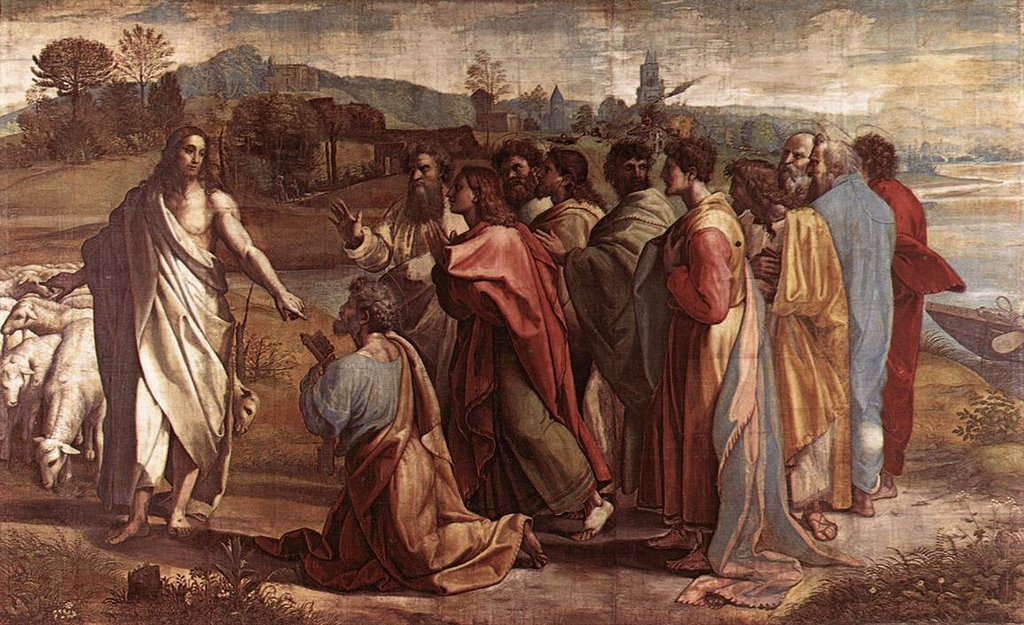
At that time, Jesus revealed Himself again to His disciples at the Sea of Tiberias. He revealed Himself in this way. Together were Simon Peter, Thomas called Didymus, Nathanael from Cana in Galilee, Zebedee's sons, and two others of His disciples. Simon Peter said to them, "I am going fishing." They said to him, "We also will come with you." So they went out and got into the boat, but that night they caught nothing. When it was already dawn, Jesus was standing on the shore; but the disciples did not realize that it was Jesus. Jesus said to them, "Children, have you caught anything to eat?" They answered Him, "No." So He said to them, "Cast the net over the right side of the boat and you will find something." So they cast it, and were not able to pull it in because of the number of fish. So the disciple whom Jesus loved said to Peter, "It is the Lord." When Simon Peter heard that it was the Lord, he tucked in his garment, for he was lightly clad, and jumped into the sea. The other disciples came in the boat, for they were not far from shore, only about a hundred yards, dragging the net with the fish. When they climbed out on shore, they saw a charcoal fire with fish on it and bread. Jesus said to them, "Bring some of the fish you just caught." So Simon Peter went over and dragged the net ashore full of one hundred fifty-three large fish. Even though there were so many, the net was not torn. Jesus said to them, "Come, have breakfast." And none of the disciples dared to ask Him, "Who are You?" because they realized it was the Lord. Jesus came over and took the bread and gave it to them, and in like manner the fish. This was now the third time Jesus was revealed to His disciples after being raised from the dead.
When they had finished breakfast, Jesus said to Simon Peter, "Simon, son of John, do you love (diligis) Me more than these?" Simon Peter answered him, "Yes, Lord, You know that I love (amo) you." Jesus said to him, "Feed My lambs." He then said to Simon Peter a second time, "Simon, son of John, do you love (diligis) Me?" Simon Peter answered Him, "Yes, Lord, you know that I love (amo) You." Jesus said to him, "Tend My sheep." Jesus said to him the third time, "Simon, son of John, do you love (amas) Me?" Peter was distressed that Jesus had said to him a third time, "Do you love (amas) Me?" and he said to Him, "Lord, You know everything; you know that I love (amo) You." Jesus said to him, "Feed My sheep. Amen, amen, I say to you, when you were younger, you used to dress yourself and go where you wanted; but when you grow old, you will stretch out your hands, and someone else will dress you and lead you where you do not want to go." He said this signifying by what kind of death he would glorify God. And when He had said this, He said to him, "Follow me.”

Jesus asks a first time if Peter diligit Jesus. Peter says he amat Him.
Jesus asks a second time if Peter diligit Jesus. Peter says again he amat Him.
The thrid time Jesus shows Peter his own words by basically saying, “Peter, do you only amas me?” Peter was hurt because Jesus asked if he amat Jesus instead of diligens Him. Peter knew he was “caught” and had to admit that Jesus knew all and He knew that Peter only amat Him. Thus Jesus strengthens Him by basically saying that Peter will be called upon to diligere Him, “by what kind of death he would glorify God.”