
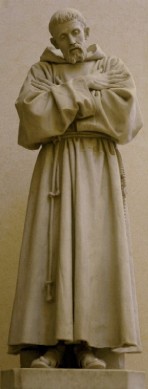




Time for some levity.
A classic. It pretty much sums up all the things I hate about the commercialization and secularization of Christmas.
The Twelve Pains of Christmas by Bob Rivers. Well done homemade video too.
RS
Tuesday, December 16, 2008

Saturday, December 13, 2008
Comparison of Prayers - 3rd Sunday of Advent
Gaudete Sunday

"John the Baptist" by Titian
“There was a man sent from God, whose name was John. This man came for a witness, to give testimony of the Light, that all men might believe through him. He was not the Light, but was to give testimony of the Light. And this is the testimony of John, when the Jews sent from Jerusalem priests and Levites to him, to ask him: 'Who art thou?' And he confessed, and did not deny: and he confessed: 'I am not the Christ.' And they asked him: 'What then? Art thou Elias?' And he said: 'I am not.' 'Art thou the prophet?' And he answered: 'No.' They said therefore unto him: 'Who art thou, that we may give an answer to them that sent us? What sayest thou of thyself?' He said: 'I am the voice of one crying out in the wilderness, make straight the way of the Lord, as said the prophet Isaias.' And they that were sent, were of the Pharisees. And they asked him, and said to him: 'Why then dost thou baptize, if thou be not Christ, nor Elias, nor the prophet?' John answered them, saying: 'I baptize with water; but there hath stood One in the midst of you, Whom you know not. The same is He that shall come after me, Who is preferred before me: the latchet of whose shoe I am not worthy to loose.' These things were done in Bethania, beyond the Jordan, where John was baptizing.”
Collect (Opening Prayer)
Official Latin from the 1969 & 2002 Roman Missals
Orémus. Deus, qui cónspicis pópulum tuum nativitátis domínicæ festivitátem fidéliter exspectáre, præsta, quaésumus, ut valeámus ad tantæ salútis gáudia perveníre, et ea votis sollémnibus álacri semper lætítia celebráre.
Per Dóminum nostrum Iesum Christum, Fílium tuum, qui tecum vivit et regnat in unitáte Spíritus Sancti, Deus, per ómnia saécula sæculórum.
Official 1973 I.C.E.L. Translation (Used at Mass in English)
Let us pray. Lord God, may we, your people, who look forward to the birthday of Christ experience the joy of salvation and celebrate that feast with love and thanksgiving.
We ask this through our Lord Jesus Christ, your Son, who lives and reigns with you and the Holy Spirit, one God, for ever and ever.
My Own Literal Translation
Let us pray. O God, You Who look attentively upon Your people faithfully awaiting the feast day of the birth of the Lord, grant, we beseech You, that we may be worthy to attain to the joys of so great a salvation, and to celebrate them always with eager joy through these solemn offerings.
Through our Lord Jesus Christ, Your Son, Who lives and reigns with You, in the unity of the Holy Spirit, one God, forever and ever.
Prayer Over the Gifts
Official Latin from the 1969 & 2002 Roman Missals
Devotiónis nostræ tibi, Dómine, quaésumus, hóstia iúgiter immolétur, quæ et sacri péragat institúta mystérii et salutáre tuum nobis poténter operétur.
Per Christum Dóminum nostrum.
Official 1973 I.C.E.L. Translation (Used at Mass in English)
Lord, may the gift we offer in faith and love be a continual sacrifice in your honor and truly become our eucharist and our salvation.
Grant this through Christ our Lord.
My Own Literal Translation
May this Sacrifice of our devotion, we beseech You, O Lord, be continually offered to You, that It may both accomplish the purpose of this Sacred Mystery and powerfully work in us Your salvation.
Through Christ our Lord.
Preface
Preface I of Advent: On the two comings of Christ
Official Latin from the 1969 & 2002 Roman Missals
Vere dignum et iustum est, æquum et salútare, nos tibi semper et ubíque grátias ágere: Dómine, sancte Pater, omnípotens ætérne Deus: per Christum Dóminum nostrum.
Qui, primo advéntu in humilitáte carnis assúmptæ, dispositiónis antíquæ munus implévit, nobísque salútis perpétuæ trámitem reserávit: ut, cum secúndo vénerit in suæ glória maiestátis, manifésto demum múnere capiámus, quod vigilántes nunc audémus expectáre promíssum.
Et ídeo cum Angelis et Archángelis, cum Thronis et Dominatiónibus, cumque omni milítia cæléstis exércitus, hymnum glóriæ tuæ cánimus, sine fine dicéntes:
Sanctus, Sanctus, Sanctus ...
Official 1973 I.C.E.L. Translation (Used at Mass in English)
Father, all-powerful and ever-living God, we do well always and everywhere to give you thanks through Jesus Christ our Lord.
When he humbled himself to come among us as a man, he fulfilled the plan you formed long ago and opened for us the way to salvation. Now we watch for the day, hoping that the salvation promised us will be ours when Christ our Lord will come again in his glory.
And so, with all the choirs of angels in heaven we proclaim your glory and join in their unending hymn of praise:
Holy, holy, holy ...
My Own Literal Translation
It is truly right and just, proper and availing unto salvation, that we always and everywhere give thanks to You, O Lord, Holy Father, Almighty and Eternal God: through Christ our Lord.
Who, in His first coming in the lowliness of assumed flesh, fulfilled the work of Your ancient arrangement, and opened to us the path to eternal salvation: so that, when He will come again in the Glory of His Majesty, we may then indeed openly take hold of that gift, a promise which we now dare to await with vigilance.
And so, with the Angels and Archangels, with the Thrones and Dominations, and with all the host of the Heavenly Army, we sing the hymn of Your Glory, saying without end:
Holy, Holy, Holy ...
Post-Communion Prayer
Official Latin from the 1969 & 2002 Roman Missals
Orémus. Tuam, Dómine, cleméntiam
implorámus, ut hæc divína subsídia, a vítiis expiátos, ad festa ventúra nos praéparent.
Per Christum Dóminum nostrum.
Official 1973 I.C.E.L. Translation (Used at Mass in English)
Let us pray. God of mercy, may this eucharist bring us your divine help, free us from our sins, and prepare us for the birthday of our Savior,
who is Lord for ever and ever.
My Own Literal Translation
Let us pray. We beg of Your merciful love, O Lord, that this Divine Assistance, by atoning for our offenses, may prepare us for the coming Feast day.
Through Christ our Lord.
RS
Friday, December 12, 2008
Church issues bioethical document.
The Congregation for the Doctrine of the Faith has issued a bioethical document addressing many of the current problems and trends in our present times.
It addresses things like:
- Embryonic and adult stem cell research
- Contraception, especially oral contraceptives
- Receiving vaccines which were derived from aborted fetuses
- In vitro fertilization and test tube babies.
- Frozen embryos.
- Gene therapy
- Human cloning
The document can be found here:
Dignitatis Personae (The Dignity of a Person) at the USCCB website. (document in pdf format)
A VERY important document for our times. President-elect Obama needs to read this if he's as open minded as he says he is.
It's also Providential to find the document on the Feast of Our Lady of Guadalupe, who is the patroness of the unborn and who helped convert a nation which practiced human sacrifice. Maybe this document can be a help in converting our own nation of the Untied States from it's human sacrifice of abortion and euthanasia.
Our Lady of Guadlupe, ora pro nobis!

RS
Thursday, December 11, 2008
Pope Saint Damasus I
Today is the feast of Pope Saint Damasus I. Although he is not very well known, he did have great influence upon the Church. He was the one who commissioned Saint Jerome to translate the Bible which resulted in the Vulgate translation of the Bible. He also decreed the canon of the New Testament, ie what books officially make up the New Testament.
He is buried in Rome in the church of San Lorenzo in Damaso. I was able to visit him my last time in Rome. It is not an easy place to find. I walked past it once before I found it. The outside isn't really that "churchy". The name of the church comes from the fact that it is believed that the pope himself founded this church on his own home and dedicated it to Saint Lawrence.

However, the inside is simple (well for a church in Rome), but beautiful. It's also nice and quiet.

He is buried under the altar here.

And when I got there, I noticed there is another Saint buried there as well.

Saint Eutychius, Martyr. Unfortunately, I can't really find any information about him. I think he is the Saint Eutychius whose feast is on February 4th.

Pope Saint Damasus I and Saint Eutychius, orate pro nobis.
RS
Wednesday, December 10, 2008
Our Lady of Loreto
Today is the Feast of Our Lady of Loreto.
Loreto is a town in upper-mideast Italy which has the Holy House where the Angel Gabriel visited Mary on the Annunciation. Obviously, the house was originally in Nazareth. Legend says that the House was carried by Angels one night, and brought to Loreto. Although embellished, it is based on historical fact. Back during the Crusades, many Western Christians were bringing back relics from the Holy Land to rescue them from the Muslims. Sometimes for pious reasons and sometimes for more worldly reasons.
Anyway, the Angeli family (brought by "Angels") helped to bring the Holy House to Italy in Loreto and a basilica was built around it.
I was very blessed to be able to go there on my last trip to Italy back this October.
If you go there today, you have to go up on top of the large hill where the city is. At the top you'll come to a large fortress structure.

Then going through the gate, you'll see the basilica.

Then in the middle of the basilica is the Holy House. You can't see the outside of the house because it is covered in marble with reliefs.

I wasn't able to get a picture of the inside since they were strict about pictures and there were A LOT of people praying in there, so I didn't want to disturb them. So here's a picture I pulled off the web.

Fr. Benedict was able to say his 2nd Mass here in Latin, which I was blessed to serve. It really struck me when we processed in, as right behind the altar in gold letters you see:
"HIC VERBUM CARO FACTUM EST"
("HERE THE WORD WAS MADE FLESH")
And to think that Father Benedict was about to bring that about again at the Consecration as he said the Holy Sacrifice of the Mass. It was a very profound experience.
There's also a custom in the mountain towns which I find rather humorous. In Norcia, and I believe other mountain towns in Italy, on the Feast of Our Lady of Loreto, they build these huge bonfires in the piazzas of the town.

Bonfire in the Piazza di San Lorenzo in Norcia on the Feast of Our Lady of Loreto, 2001
This commemorates the legend of when the Angels carried the Holy House through the night to Loreto, and the Italians will light bonfires in the mountian towns to "guide" the Angels to Loreto so they don't bump into the mountains. I don't know why, but I find it humorous.
Anyway, today is a great opportunity to meditate upon the Annunciation and the fact that God became man. For a good meditation, here's an excellent homily by Fr. Angelo Geiger, FFI:
Homily on the Immaculate Conception

"The Annunciation" by Philippe Champaigne
RS
Loreto is a town in upper-mideast Italy which has the Holy House where the Angel Gabriel visited Mary on the Annunciation. Obviously, the house was originally in Nazareth. Legend says that the House was carried by Angels one night, and brought to Loreto. Although embellished, it is based on historical fact. Back during the Crusades, many Western Christians were bringing back relics from the Holy Land to rescue them from the Muslims. Sometimes for pious reasons and sometimes for more worldly reasons.
Anyway, the Angeli family (brought by "Angels") helped to bring the Holy House to Italy in Loreto and a basilica was built around it.
I was very blessed to be able to go there on my last trip to Italy back this October.
If you go there today, you have to go up on top of the large hill where the city is. At the top you'll come to a large fortress structure.

Then going through the gate, you'll see the basilica.

Then in the middle of the basilica is the Holy House. You can't see the outside of the house because it is covered in marble with reliefs.

I wasn't able to get a picture of the inside since they were strict about pictures and there were A LOT of people praying in there, so I didn't want to disturb them. So here's a picture I pulled off the web.

Fr. Benedict was able to say his 2nd Mass here in Latin, which I was blessed to serve. It really struck me when we processed in, as right behind the altar in gold letters you see:
("HERE THE WORD WAS MADE FLESH")
And to think that Father Benedict was about to bring that about again at the Consecration as he said the Holy Sacrifice of the Mass. It was a very profound experience.
There's also a custom in the mountain towns which I find rather humorous. In Norcia, and I believe other mountain towns in Italy, on the Feast of Our Lady of Loreto, they build these huge bonfires in the piazzas of the town.

This commemorates the legend of when the Angels carried the Holy House through the night to Loreto, and the Italians will light bonfires in the mountian towns to "guide" the Angels to Loreto so they don't bump into the mountains. I don't know why, but I find it humorous.
Anyway, today is a great opportunity to meditate upon the Annunciation and the fact that God became man. For a good meditation, here's an excellent homily by Fr. Angelo Geiger, FFI:
Homily on the Immaculate Conception

RS
Tuesday, December 09, 2008
Religious persecution and the rise of communism
Although there is a lot in the gloom and doom crowd who are fearing the complete supression of religion under Obama, I think we have to realize that we here in the United States are VERY blessed with religious freedom to the degree in which we have it. But in spite of what happens, I think all Catholics and other Christians need to ask ourselves: if religious persecution does happen, are we willing to stand up and sacrifice ourselves for the Truth? I think many of us fear increases in religious persecution because it might mean we would have to do something and put ourselves in the way of danger and stand up for our beliefs and convitions ... and really look at ourselves and see if we really believe our beliefs and are convicted about our convictions.
It reminds me of a friend of mine who was born in Cuba and was a small boy when the communist revolution there happened. He said that Catholics who had been going to daily Mass for years were suddenly persecuting the Church and handing over priests to be arrested. He ended up fleeing Cuba with his mother. I can tell you, the popularity of the Che Guevara icon and the pro-Cuba leanings of many in the entertainment industry drives him nuts.

Fr. Tim Finigan at The Hermeneutic of Continuity posted this video from the Don Camillo series in Italy, which should be a reminder that religious persecution has been pretty recent.
And communism is still a player in Italian politics. I took this photo in October of 2008 just outside of Norcia, Italy:

And, sadly, the Democratic party has been sliding down the path to socialism and communism as well, esepecially under Barak Obama. It's a slippery slope, and once a country falls under it's spell, it is hard to let it go. As momentous as the fall of communism was in the Soviet Union, there is a growing number of people in Russia who want communism back. People had become so dependant on the government, that they are willing to throw away liberties to have programs spoon fed to them by the government again.
Hopefully, our country can wake up from its morbid fascination with socialism and move back to freedom and responsibility.
RS
Monday, December 08, 2008
Plenary Indulgence for those Consecrated to Mary

Saint Maximilian Kolbe, O.F.M.Conv.
PLENARY INDULGENCE REMINDER
There is a plenary indulgence for those who are the enrolled in Militia Immaculata (Knights of the Immaculata) and renew their Consecration to Mary according to Saint Maximilian Kolbe on December 8th (or are making their consecration on Dec 8th). The other usual requirements for a plenary indulgence apply:
“23. 1. Besides the exclusion of all attachment to sin, even venial sin, the requirements for gaining a Plenary Indulgence are the performance of the indulgenced work and fulfillment of three conditions: Sacramental Confession, Eucharistic Communion, and prayer for the Pope’s intentions.
2. Several Plenary Indulgences may be gained on the basis of a single Sacramental Confession; only one may be gained, however, on the basis of a single Eucharistic Communion and prayer for the Pope’s intentions.
3. The three conditions may be carried out several days preceding or following performance of the prescribed work. But it is more fitting that the Communion and the prayer for the Pope’s intentions take place on the day the work is performed.
4. If a person is not fully disposed or if the prescribed work and the three mentioned conditions are not fulfilled, the Indulgence will only be partial ...”
5. The condition requiring prayer for the Pope’s intentions is satisfied by reciting once the Our Father and Hail Mary for his intentions (Pater Noster and Ave Maria); nevertheless all the faithful have the option of reciting any other prayer suited to their own piety and devotion.”
- Handbook of Indulgences, Norms
More info can be found at the U.S. site for the
Militia of the Immaculata at Marytown
I'm not sure if there is a plenary indulgence for those who are consecrated to Mary according to Saint Louis de Montfort's formula. Maybe some readers would know (and if so, could provide sources).
RS
Sunday, December 07, 2008
Comparison of Prayers - Solemnity of the Immaculate Conception of the Blessed Virgin Mary

Collect (Opening Prayer)
Official Latin from the 1969 & 2002 Roman Missals
Orémus. Deus, qui per immaculátam Vírginis Conceptiónem dignum Fílio tuo habitáculum præparásti, quaésumus, ut, qui ex morte eiúsdem Fílii tui prævísa, eam ab omni labe præservásti, nos quoque mundos, eius intercessióne, ad te perveníre concédas.Per Dóminum nostrum Iesum Christum, Fílium tuum, qui tecum vivit et regnat in unitáte Spíritus Sancti, Deus, per ómnia saécula sæculórum.
Official 1973 I.C.E.L. Translation (Used at Mass in English)
Let us pray. Father, you prepared the Virgin Mary to be the worthy mother of your Son. You let her share beforehand in the salvation Christ would bring by his death, and kept her sinless from the first moment of her conception. Help us by her prayers to live in your presence without sin.
We ask this through our Lord Jesus Christ, your Son, who lives and reigns with you and the Holy Spirit, one God, for ever and ever.
My Own Literal Translation
Let us pray. O God, Who through the Immaculate Conception of the Virgin prepared a worthy dwelling for Your Son, we beseech You, that, as by the same Son’s anticipated death, You preserved her from all stain, You may also grant to us, through her intercession, to be cleansed of our sin, and to come unto You.
Through our Lord Jesus Christ, Your Son, Who lives and reigns with You, in the unity of the Holy Spirit, one God, forever and ever.
Prayer Over the Gifts
Official Latin from the 1969 & 2002 Roman Missals
Salutárem hóstiam, quam in sollemnitáte immaculátæ Conceptiónis beátæ Vírginis Maríæ tibi, Dómine, offérimus, súscipe dignánter, et præsta, ut, sicut illam tua grátia præveniénte ab omni labe profitémur immúnem, ita, eius intercessióne, a culpis ómnibus liberémur.
Per Christum Dóminum nostrum.
Official 1973 I.C.E.L. Translation (Used at Mass in English)
Lord, accept this sacrifice on the feast of the sinless Virgin Mary. You kept her free from sin from the first moment of her life. Help us by her prayers, and free us from our sins.
We ask this in the name of Jesus the Lord.
My Own Literal Translation
O Lord, kindly accept this saving Victim, Which we offer to You on this solemnity of the Immaculate Conception of the Blessed Virgin Mary, and grant, that, as we profess her being preserved from all stain through Your surpassing grace, so also, through her intercession, may we be freed from all our faults.
Through Christ our Lord.
Preface
Preface of the Immaculate Conception - on the Mystery of Mary and the Church
Official Latin from the 1969 & 2002 Roman Missals
Vere dignum et iustum est, æquum et salútare, nos tibi semper et ubíque grátias ágere: Dómine, sancte Pater, omnípotens ætérne Deus:
Qui, beatíssimam Vírginem Maríam ab omni originális culpæ labe præservásti, ut in ea, grátiæ tuæ plenitúdine ditáta, dignam Fílio tuo Genetrícem præparáres, et Sponsæ eius Ecclésiæ, sine ruga vel mácula formosæ, signáres exórdium.
Fílium enim erat puríssima Virgo datúra, qui crímina nostra Agnus ínnocens aboléret; et ipsam præ ómnibus tuo pópulo disponébas advocátam grátiæ et sanctitátis exémplar.
Et ídeo, choris Angélicis sociáti, te laudámus in gáudio confiténtes:
Sanctus, Sanctus, Sanctus ...
Official 1973 I.C.E.L. Translation (Used at Mass in English)
Father, all-powerful and ever-living God, we do well always and everywhere to give you thanks.
You allowed no stain of Adam’s sin to touch the Virgin Mary. Full of grace, she was to be a worthy mother of your Son, your sign of favor to the Church at its beginning, and the promise of its perfection as the bride of Christ, radian in beauty.
Purest of virgins, she was to bring forth your Son, the innocent lamb who takes away our sins. You chose her from all women to be our advocate with you and our pattern of holiness.
In our joy we sing to your glory with all the choirs of angels:
Holy, holy, holy ...
My Own Literal Translation
It is truly right and just, proper and availing unto salvation, that we always and everywhere give thanks to You, O Lord, Holy Father, Almighty and Eternal God:
You preserved the most Blessed Virgin Mary from all stain of original sin, so that in her, enriched with the fullness of Your grace, You were preparing her as the worthy Mother of Your Son, and of His Spouse the Church, without wrinkle or stain to her beauty, You sealed her from the beginning.
For she was the most pure Virgin about to bring forth Your Son, the innocent Lamb Who destroys our offenses; and You arranged for her to be an advocate for Your people as an example of grace and holiness in the sight of all.
And so, with the choirs of the host of Angels, we praise You in joy professing:
Holy, Holy, Holy ...
Post-Communion Prayer
Official Latin from the 1969 & 2002 Roman Missals
Orémus. Sacraménta quæ súmpsimus, Dómine Deus noster, illíus in nobis culpæ vúlnera réparent, a qua immaculátam beátæ Maríæ Conceptiónem singuláriter præservásti.
Per Christum Dóminum nostrum.
Official 1973 I.C.E.L. Translation (Used at Mass in English)
Let us pray. Lord our God, in your love, you chose the Virgin Mary and kept her free from sin. May this sacrament of your love free us from our sins.
Grant this through Christ our Lord.
My Own Literal Translation
Let us pray. O Lord our God, may the Sacraments Which we have received heal in us the wounds of that original sin, from which You singularly preserved the Immaculate Conception of Blessed Mary.
Through Christ our Lord.
RS
Saturday, December 06, 2008
Saint Leontia
Ted from Canada had emailed me asking about a Saint Leontia in my list of Saints I visted on my last pilgrimage to Rome.
Yes, the Saint referred to in my list is a martyr buried in San Francesco a Ripa.

Saint Leontia at San Francesco a Ripa in Rome
I honestly cannot confirm much about her. There is a Saint Leontia in the Roman Martyrology, and her feast day is today, December 6th. However, I am not sure if the Saint in the Martyrology is the same as the Saint shown above.
The entry is:
(Sorry, it's a good site for the old martyrology, but the site is run by sedevacantists).
Yet, the Saint Leontia at San Francesco a Ripa may be a little obscure Roman Martyr who, although not much was know about her life, was known to have been martyried for the faith.
The only other possible hint may be on the name plate on her tomb. It says: "CORPUS.S.LEONTIAE MART.NOM.PR."

click picture to embiggen
I'm not really sure what the "NOM.PR." part means.
So, if anyone has more information on this Saint Leontia buried in San Francesco a Ripa in Rome, I'd appreciate you letting me know. Otherwise, we'll assume this is the same Saint mentioned in the Roman Martyrology.
And also, happy feast of Saint Nicholas.
RS
What can you tell me about Saint Leontia, and is this
the individual buried in San Francesco a Ripa Church in
Trastevere, Rome?
Yes, the Saint referred to in my list is a martyr buried in San Francesco a Ripa.

I honestly cannot confirm much about her. There is a Saint Leontia in the Roman Martyrology, and her feast day is today, December 6th. However, I am not sure if the Saint in the Martyrology is the same as the Saint shown above.
The entry is:
In Africa sancti Majórici, fílii sanctæ Dionysiæ, qui, cum esset adolescéntulus ac torménta pavésceret, matris obtútibus verbísque corroborátus est, et, céteris fórtior factus, in torméntis ánimam réddidit; quem amplexáta mater domi sepelívit, et ad ejus sepúlcrum assídue oráre consuévit.- from breviary.net's Roman Maryrology pages
Ibídem sanctárum mulíerum Dionysiæ, quæ sancti Majórici Mártyris éxstitit mater, Datívæ ac Leóntiæ; itémque religiósi viri, nómine Tértii, Æmiliáni médici, et Bonifátii, cum áliis tribus. Hi omnes, in persecutióne Wandálica, sub Ariáno Rege Hunneríco, gravíssimis et innúmeris supplíciis pro cathólicæ fídei defensióne cruciáti, sanctórum Christi Confessórum número sociári meruérunt.
In Africa, St. Majoricus, son of St. Dionysia, who, being quite young and dreading the torments, was strengthened by the looks and words of his mother, and becoming stronger than the rest, expired in torments. His mother took him in her arms, and having buried him in her own home, was wont to pray diligently at his tomb.
In the same place, the holy women Dionysia, who was the mother of St. Majoricus the martyr, Dativa, and Leontia; also a pious man named Tertius, Emilian a physician, Boniface, and three others. In the persecution of the Vandals, under the Arian king Hunneric, they were subjected to numberless most painful tortures for the Catholic faith, and thus merited to rank among the confessors of Christ.
(Sorry, it's a good site for the old martyrology, but the site is run by sedevacantists).
Yet, the Saint Leontia at San Francesco a Ripa may be a little obscure Roman Martyr who, although not much was know about her life, was known to have been martyried for the faith.
The only other possible hint may be on the name plate on her tomb. It says: "CORPUS.S.LEONTIAE MART.NOM.PR."

I'm not really sure what the "NOM.PR." part means.
So, if anyone has more information on this Saint Leontia buried in San Francesco a Ripa in Rome, I'd appreciate you letting me know. Otherwise, we'll assume this is the same Saint mentioned in the Roman Martyrology.
And also, happy feast of Saint Nicholas.
RS
Friday, December 05, 2008
Comparison of Prayers - 2nd Sunday of Advent

Collect (Opening Prayer)
Official Latin from the 1969 & 2002 Roman Missals
Orémus. Omnípotens et miséricors Deus, in tui occúrsum Fílii festinántes nulla ópera terréni actus impédiant, sed sapiéntiæ cæléstis erudítio nos fáciat eius esse consórtes.
Qui tecum vivit et regnat, in unitáte Spíritus Sancti Deus, per ómnia saécula sæculórum.
Official 1973 I.C.E.L. Translation (Used at Mass in English)
Let us pray. God of power and mercy, open our hearts in welcome. Remove the things that hinder us from receiving Christ with joy, so that we may share his wisdom and become one with him when he comes in glory,
for he lives and reigns with you and the Holy Spirit, one God, for ever and ever.
My Own Literal Translation
Let us pray. Almighty and Merciful God, may no works of worldly deeds ensnare those hurrying to meet Your Son, but may the learning of Heavenly wisdom make us to be co-heirs of Him.
Who lives and reigns with You, in the unity of the Holy Spirit, God, forever and ever.
Prayer Over the Gifts
Official Latin from the 1969 & 2002 Roman Missals
Placáre, Dómine, quaésumus, nostræ précibus humilitátis et hóstiis, et, ubi nulla súppetunt suffrágia meritórum, tuæ nobis indulgéntiæ succúrre præsídiis.
Per Christum Dóminum nostrum.
Official 1973 I.C.E.L. Translation (Used at Mass in English)
Lord, we are nothing without you. As you sustain us with your mercy, receive our prayers and offerings.
We ask this through Christ our Lord.
My Own Literal Translation
Be appeased, we beseech You, O Lord, by the prayers and sacrificial offerings of our humility, and, where the support of our merits is insufficient, help us with the aid of Your forgiveness.
Through Christ our Lord.
Preface
Preface I of Advent: On the two comings of Christ
Official Latin from the 1969 & 2002 Roman Missals
Vere dignum et iustum est, æquum et salútare, nos tibi semper et ubíque grátias ágere: Dómine, sancte Pater, omnípotens ætérne Deus: per Christum Dóminum nostrum.
Qui, primo advéntu in humilitáte carnis assúmptæ, dispositiónis antíquæ munus implévit, nobísque salútis perpétuæ trámitem reserávit: ut, cum secúndo vénerit in suæ glória maiestátis, manifésto demum múnere capiámus, quod vigilántes nunc audémus expectáre promíssum.
Et ídeo cum Angelis et Archángelis, cum Thronis et Dominatiónibus, cumque omni milítia cæléstis exércitus, hymnum glóriæ tuæ cánimus, sine fine dicéntes:
Sanctus, Sanctus, Sanctus ...
Official 1973 I.C.E.L. Translation (Used at Mass in English)
Father, all-powerful and ever-living God, we do well always and everywhere to give you thanks through Jesus Christ our Lord.
When he humbled himself to come among us as a man, he fulfilled the plan you formed long ago and opened for us the way to salvation. Now we watch for the day, hoping that the salvation promised us will be ours when Christ our Lord will come again in his glory.
And so, with all the choirs of angels in heaven we proclaim your glory and join in their unending hymn of praise:
Holy, holy, holy ...
My Own Literal Translation
It is truly right and just, proper and availing unto salvation, that we always and everywhere give thanks to You, O Lord, Holy Father, Almighty and Eternal God: through Christ our Lord.
Who, in His first coming in the lowliness of assumed flesh, fulfilled the work of Your ancient arrangement, and opened to us the path to eternal salvation: so that, when He will come again in the Glory of His Majesty, we may then indeed openly take hold of that gift, a promise which we now dare to await with vigilance.
And so, with the Angels and Archangels, with the Thrones and Dominations, and with all the host of the Heavenly Army, we sing the hymn of Your Glory, saying without end:
Holy, Holy, Holy ...
Post-Communion Prayer
Official Latin from the 1969 & 2002 Roman Missals
Orémus. Repléti cibo spiritális alimóniæ, súpplices te, Dómine, deprecámur, ut, huius participatióne mystérii, dóceas nos terréna sapiénter perpéndere, et cæléstibus inhærére.
Per Christum Dóminum nostrum.
Official 1973 I.C.E.L. Translation (Used at Mass in English)
Let us pray. Father, you give us food from heaven. By our sharing in this mystery, teach us to judge wisely the things of earth and to love the things of heaven.
Grant this through Christ our Lord.
My Own Literal Translation
Let us pray. Having been filled with this Food of spiritual nourishment, we humbly beseech You, O Lord, that, through our participation in this Mystery, You may teach us to examine wisely the things of this world, and to cling to heavenly things.
Through Christ our Lord.
RS
Thursday, December 04, 2008
Volition

A movie to watch:
Volition
Description: "Volition (n)- The act of making a choice. Sometimes the choice of inaction has consequences stronger than we could ever imagine. Throughout history, men have been faced with difficult choices in a world that makes it easy for them to conform. This film explores the hope that lies behind every decision made in the face of adversity; the hope that is buried in the heart of those that look beyond themselves and see something bigger worth fighting for." run time: 14 min 55 sec.
Thanks to Cosmos-Liturgy-Sex for the recommendation.
RS
Wednesday, December 03, 2008
Relic of Saint Francis Xavier

Arm of Saint Francis Xavier at Il Gesu church in Rome. This arm has Baptized and blessed thousands and thousands in India and the Orient.
The body of Saint Francis Xavier is in Goa, India.
RS
Tuesday, December 02, 2008
How People Got Here #120208
More interesting searches which got people to this site.
- "ginormous cheeseburger.jpg" which is all the more interesting because it was a search from Germany.
- More than usual searches for the Motivational Saint Francis poster I found, and the Motivational Judas poster I made.
- A lot of people have been searching for Saint Christopher lately, but I'm not sure why.
- "very very very cool stuff for the romans" Sorry, I only know the very, very cool stuff, not the very, very, very cool stuff.
- "coolest alarm clock"
- "retreat with the carthusians" Your best bet is to go buy the DVD "Into Great Silence" because the Carthusians do not give retreats. The only retreat is if you are considering a vocation in which you usually have to spend a month with them.
- "Streetmentioner's Time Traveller's Handbook of 1001 Tense Formations" LOL. Don't forget your towel too.
- "meaning of handkerchif as a gift" this one just baffles me. I think it's related to a meme that asked what is in my pockets, but usually if someone offers you a handkerchif as a gift it means you have a booger on your nose.
- "no Gloria during Advent" - nope, no Gloria. One of the signs which I believe shows that Advent is more penitential than the ordinary time of the liturgical year.
- "relics of St Scholastica" ... glad you asked

Relic (forearm bone) of Saint Scholastica
RS
- "ginormous cheeseburger.jpg" which is all the more interesting because it was a search from Germany.
- More than usual searches for the Motivational Saint Francis poster I found, and the Motivational Judas poster I made.
- A lot of people have been searching for Saint Christopher lately, but I'm not sure why.
- "very very very cool stuff for the romans" Sorry, I only know the very, very cool stuff, not the very, very, very cool stuff.
- "coolest alarm clock"
- "retreat with the carthusians" Your best bet is to go buy the DVD "Into Great Silence" because the Carthusians do not give retreats. The only retreat is if you are considering a vocation in which you usually have to spend a month with them.
- "Streetmentioner's Time Traveller's Handbook of 1001 Tense Formations" LOL. Don't forget your towel too.
- "meaning of handkerchif as a gift" this one just baffles me. I think it's related to a meme that asked what is in my pockets, but usually if someone offers you a handkerchif as a gift it means you have a booger on your nose.
- "no Gloria during Advent" - nope, no Gloria. One of the signs which I believe shows that Advent is more penitential than the ordinary time of the liturgical year.
- "relics of St Scholastica" ... glad you asked

RS
Saturday, November 29, 2008
November 29th, Feast of Saint Saturninus of Carthage
(Not to be confused with Saint Saturninus of Toulouse, Bishop & Martyr whose feast is also today)
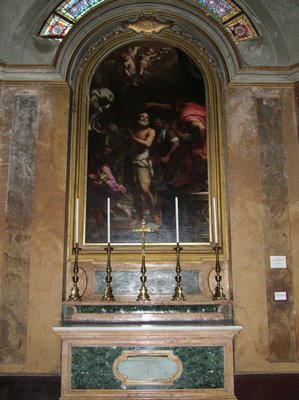
Altar and relics of Saint Saturninus of Carthage at the Basilica of Saints John and Paul in Rome
Back in 2000, I had read a story about a priest (however, it was not Saint John Marie Vianney) who had begun praying to a very obscure and unknown Saint. He reasoned that because this Saint was so unknown, she would have more "time" to pray for him and his intentions. And sure enough, intentions he had for his parish were coming to pass through the intercession of this Saint.
A few weeks after I read that story I was in Rome for the Jubilee year and my friend Father Cassian had suggested I visit the basilica of Saints John and Paul (the ones mentioned together in the Roman Canon). While I was there, I was struck by a painting and relics in a side altar of Saint Saturninus of Carthage (as seen above). And having never heard of him before, I thought about that story I had read about the priest who began praying to this obscure Saint. So, I've had a devotion to Saint Saturninus of Carthage ever since. And I was blessed to be able to visit him on my last trip to Rome back in October.

Saint Saturninus of Carthage
The new (2004) Roman Martyrology has this:
My rough translation
An older version of the Roman Martyrology has this:
(Sorry, it's a good site for the old martyrology, but the site is run by sedevacantists).
I'm not sure what happened to St. Saturninus' deacon companion Sisinius in the new Martyrology. I often worry that some parts of legends are automatically thrown out if they can't be proven, rather than keeping them until the can be proven false. I feel that is often the case in the rather snotty comments in the Thurston & Atwater edition of Butler's Lives of the Saints.
A brief article at catholicculture.org had this to say:
Saint Saturninus was originally buried in the Catacombs, and Pope Saint Damasus wrote a beautiful epitaph on his tomb there:
Epigraph of Pope Saint Damasus for St. Saturninus
source
Here's the collect for his feast (which used to be on the universal calendar before the changes of Vatican II) from the traditional Divine Office:
I have become devoted to him, and love the fact that in spite of his old age he suffered for Christ, to the point of torture, exile, more torture, and martyrdom. He does show that God chooses the weak to shame the strong.
Sancte Saturníne (et Sancte Sisinie), ora(te) pro nobis.
"To you, O Martyr Saturninus, I pay my prayerful homage" as well.
And to any priests who are saying the extraordinary form of the Mass and can follow the traditional calendar or who say the ordinary form and have a copy of the Roman Martyrology, I invite you to remember him as well.
RS
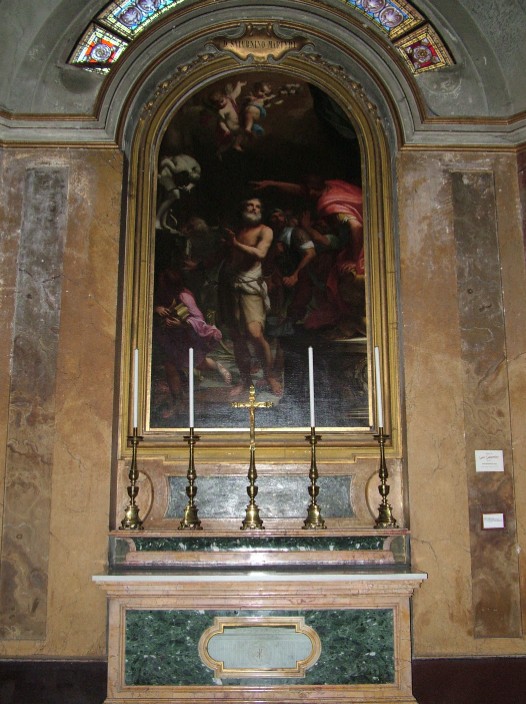
Back in 2000, I had read a story about a priest (however, it was not Saint John Marie Vianney) who had begun praying to a very obscure and unknown Saint. He reasoned that because this Saint was so unknown, she would have more "time" to pray for him and his intentions. And sure enough, intentions he had for his parish were coming to pass through the intercession of this Saint.
A few weeks after I read that story I was in Rome for the Jubilee year and my friend Father Cassian had suggested I visit the basilica of Saints John and Paul (the ones mentioned together in the Roman Canon). While I was there, I was struck by a painting and relics in a side altar of Saint Saturninus of Carthage (as seen above). And having never heard of him before, I thought about that story I had read about the priest who began praying to this obscure Saint. So, I've had a devotion to Saint Saturninus of Carthage ever since. And I was blessed to be able to visit him on my last trip to Rome back in October.
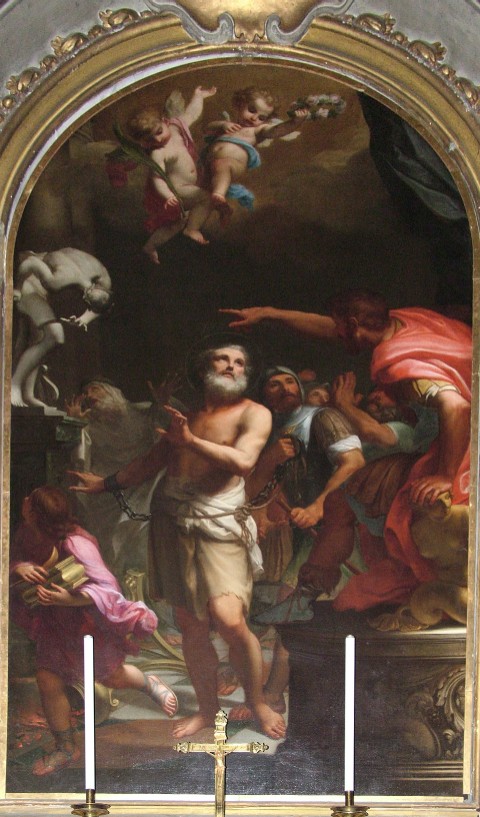
The new (2004) Roman Martyrology has this:
Romæ in cœmetério Trasónis via Salária Nova, sancti Saturníni Carthaginénsis, mártyris, qui, ut sanctus Dámasus papa refert, sub Décio imperatóre pro Christo in pátria in ecúleo impósitus est et Romam extórris missus, ubi, áliis atrócibus torméntis superátis, Gratiánum tyránnum ad fidem convértit et cápite obtruncáto corónam martýrii adéptus est.
My rough translation
At Rome, in the cemetary of Trasonis on the New Via Salaria, Saint Saturninus of Carthage, martyr, who, Pope Saint Damasus relates, that under the Emperor Decius, in his homeland he [St. Saturninus] was placed on the rack for Christ, and sent into exile in Rome, where, having overcome other severe tortures, converted the tyrant Gratianus to the faith, and [St. Saturninus] being beheaded obtained the crown of martyrdom.
An older version of the Roman Martyrology has this:
Romæ, via Salaria, natális sanctórum Mártyrum Saturnini senis, et Sisinii Diáconi, sub Maximiáno Príncipe; quos, diu in cárcere maceratos, jussit Urbis Præfectus in equuleum levári et attrahi nervis, fustibus ac scorpiónibus cædi, deínde eis flammas apponi, et, depositos de equuleo, cápite truncari.- from breviary.net's Roman Maryrology pages
At Rome, on the Salarian Way, the birthday of the holy martyr, Saturninus, an aged man, and the deacon Sisinius, in the time of Emperor Maximian. After a long imprisonment, by order of the prefect of the city they were placed on the rack, stretched with ropes, scourged with rods and whips garnished with metal, then exposed to the flames, taken down from the rack and beheaded.
(Sorry, it's a good site for the old martyrology, but the site is run by sedevacantists).
I'm not sure what happened to St. Saturninus' deacon companion Sisinius in the new Martyrology. I often worry that some parts of legends are automatically thrown out if they can't be proven, rather than keeping them until the can be proven false. I feel that is often the case in the rather snotty comments in the Thurston & Atwater edition of Butler's Lives of the Saints.
A brief article at catholicculture.org had this to say:
St. Saturninus
The Martyrology gives these details: "At Rome on the Via Salaria the death of the holy martyr, the aged Saturninus, and of the deacon Sisinius. Under the emperor Maximianus they suffered long in prison. The prefect of Rome ordered them placed on the rack till their joints were torn loose, then beaten with knotted whips, and burnt with torches; at last removed from the rack, they were beheaded." According to the inscription on his tomb by Pope St. Damasus, Saturninus hailed from Carthage. The Acts of Marcellus say he was condemned as a frail old man to carry sand for the construction of the Baths of Diocletian; but when by his patience and prayer and encouragement he led many to the faith, he was beheaded.
Saint Saturninus was originally buried in the Catacombs, and Pope Saint Damasus wrote a beautiful epitaph on his tomb there:
Epigraph of Pope Saint Damasus for St. Saturninus
Citizen now of Christ, formerly of Carthage,
The moment the sword pierced the Mother's holy breast,
through her blood he changed country, name and lineage,
the birth to the life of the saints made him a Roman citizen.
His faith was wonderful: as his heroic death would later show.
His enemy Gratianus trembled while he tore his holy members;
but though all his venomous rage exploded,
he could not induce you, O Saint, to deny Christ;
indeed through your prayers he even deserved to die a Christian.
This is the will of the suppliant Damasus: venerate this tomb!
[Here it is given to fulfil vows and to pour out chaste prayers,
because it is the tomb of the martyr St Saturninus]
To you, O Martyr Saturninus, I pay my prayerful homage.
source
Here's the collect for his feast (which used to be on the universal calendar before the changes of Vatican II) from the traditional Divine Office:
Orémus.
Deus, qui nos beáti Saturníni Mártyris tui concédis natalício pérfrui: eius nos tríbue méritis adiuvári. Per Dóminum nostrum Iesum Christum, qui tecum vivit et regnat in unitáte Spíritus Sancti Deus, per ómnia saécula sæculórum. Amen.
Let us pray.
O God, Who givest us to rejoice in the feast of Thy blessed Martyr Saturninus: grant that we may be helped by his merits. Through our Lord Jesus Christ Thy Son, Who livest and reignest with Thee in the unity of the Holy Spirit, God, forever and ever. Amen.
I have become devoted to him, and love the fact that in spite of his old age he suffered for Christ, to the point of torture, exile, more torture, and martyrdom. He does show that God chooses the weak to shame the strong.
Sancte Saturníne (et Sancte Sisinie), ora(te) pro nobis.
"To you, O Martyr Saturninus, I pay my prayerful homage" as well.
And to any priests who are saying the extraordinary form of the Mass and can follow the traditional calendar or who say the ordinary form and have a copy of the Roman Martyrology, I invite you to remember him as well.
RS
Is Advent penitential or not?
It appears that a few bloggers have already published thier Advent rants [cough]Fr. Z, Fr. Erik[cough] [LOL], so I am going to re-re-publish this post which appeared last year around this time (I guess this will become a tradition now).
Oh, and I'd like to point out that "Advent Penitential Services" are really unnecessary. I think it'd really be better if the pastor or priests at a parish just make confessions readily available REGULARLY (ie more than 1 hour a week) THROUGHOUT THE ENTIRE YEAR, instead of only having an annual or semi-annual "penitential service." These things are not a part of our Catholic tradition. If you offer confession, they will come. Our priest, in a small parish in a small town, hears confessions at least an hour a day at least 6 days a week. And people actually come. And as for penitential services, general absolution is not allowed in these things, so if your priest or pastor does it, he is committing an abuse. Anyway, enough on that rant ... on with the traditional post:
A lot of people have been searching for this, so I am going to re-publish this post.
I'm also updating the post because of a little detail noticed over at The New Liturgical Movement. Saturday evening, at the 1st Vespers of Advent [last year], the pope wore the Penitential Papal Formale:

Looks like that hermeneutic of continuity is showing it's hand again.
You can read NLM's report about it here:
The penitential Papal Formale (it's back)
The following was originally posted 12/4/06.
Wow, ask a simple question ... and what a confusing journey on which you find yourself.
A friend and I wrote to Jimmy Akin asking whether he knew if Advent was penitential. He attempted to answer our emails in his post the next day. To summarize his post, he concludes,
Now, on a technical level I understand his conclusion, and part of it is that the questions that my friend and I asked were different. Basically, my friend asked "legally what are we as the faithful bound to do during Advent?" as in comparison to Lent when we are legally (in Canon law) bound to fast on Ash Wednesday and Good Friday and abstain from meat on the Fridays of Lent.
So, I thought Jimmy wrong until I re-read and saw that his conclusion is based on the above question and that he did say, "at least in the universal law of the Latin Church." [emphasis mine]
However, my question was a bit more general and focused on the nature of Advent. "Is Advent penitential?" What raised this question for me was from my liturgical studies. In his book "Ceremonies of the Liturgical Year According to the Modern Roman Rite," Msgr. Peter Elliot says right off the bat in his section on Advent, "The season with which the liturgical year begins is not penitential." (p.34, #42).
This statement suprises me. I was raised with the understanding that Advent was sort of like a less rigid Lent. It wasn't as somber or rigorous as Lent, but nonetheless it had a penitential spirit about it. I mean, first off, there seem to be signs in the liturgy. Just as in Lent, the color of the vestments are violet, there is a week where rose may be worn (3rd Sunday of Advent and 4th Sunday of Lent), "the use of the organ and other musical instruments and the decorating of the altar with flowers should be done in a moderate manner, as is consonant with the character of the season, without anticipating the full joy of Christmas (Ceremonial of Bishops, #236), and there is no Gloria on Sundays of Advent. Even in regards to the celebration of Matrimony, "When a marriage is celebrated during Advent or Lent or other days of penance, the parish priest should advise the couple to take into consideration the special nature of these liturgical seasons." That makes it sound like Advent, Lent, and penitential days are pretty much in the same category.
Of course some will say that the violet used in advent is of a different hue, as even our diocesan ordo says "In order to distinguish between this season [of Advent] and the specifically penitential season of Lent, the bluer hues of violet may be used during Advent. Light blue vestments, however, are not authorized for use in the United States." So that statement seems to say that Advent is not specifically penitential as Lent is. However, it should also be noted that this distinction of hues is not a necessity either. The Generial Instruction on the Roman Missals just says that "violet" is to be used for Advent and Lent.
So, off the shelves come the liturgical books. At this point, I am wondering what is the nature of Advent? When did it start? How did it develop? Such a simple question should not be that hard to answer. So, in remembering that one of the reasons why I started this blog was that I was asked to share my liturgical knowledge, I dove into my personal library seeking out info on Advent.
The new "Compendium: Catechism of the Catholic Church" really only says about Advent,
The Catechism of the Catholic Church" says:
Hmmm, not very helpful yet. The season of Advent really isn't dealt with on a technical level, so I have few books that deal with the subject.
"The General Norms for the Liturgical Year and the Calendar" say this:
I think a key point here is that the coming of Christ is to be emphasized. Not only in celebrating His first coming when he was conceived and 9 months later born, but also His second coming, which will be the final judgement.
In "The Mass: A Study of the Roman Liturgy" Fr. Adrian Fortesque says this about Advent when looking the how the Gloria developed in the Mass:
Interesting. He says that the season developed into a more penitential season.
"The New Dictionary of the Liturgy" by Gerhard Podhradsky, has this for its entry on Advent:
So while it does have a penitential aspect to it, it is not "strictly" penitential as is Lent.
Finally, I scrounged around and from the back corner of my closet I found Father Josef Jungmann's "The Early Liturgy," which has an analysis of the early development of Advent. He says that
He also says that the earliest records of Advent in Rome are from Saint Gregory the Great's four Advent sermons.
Here's a clue:
He goes on to talk about the technicalities of Advent's development in Rome and in Gaul and the Gallic influence that came into Rome. He eventually continues:
And then finally! An answer:
So in conclusion, it does appear that Advent has a spirit of penance to it. Although it initially wasn't, through Gallic influences, the Roman practice adopted a more penitential practice which eventually became the universal form. This aspect of penance derives from the expectation of Christ's second coming, and thus finds the faithful joyfully preparing themselves for Our Lord's coming at the end of time and the final judgement. This also helps us to prepare for the commemoration of the Lord's first coming which we celebrate at Christmas. This penitential shift is reflected in the liturgical practices of the rite. However, this season is not strictly penitental and thus does not have required fasting as Lent does, but allows for other anticipatory customs as well. Thus, while there is no legal obligation upon the faithful as there is in Lent, if we are going to follow a true "hermeneutic of continuity" then in my opinion it is a penitential season.
Other Advent links:
The History of Advent at intermirifica
Advent in the Catholic Encyclopedia
RS
Oh, and I'd like to point out that "Advent Penitential Services" are really unnecessary. I think it'd really be better if the pastor or priests at a parish just make confessions readily available REGULARLY (ie more than 1 hour a week) THROUGHOUT THE ENTIRE YEAR, instead of only having an annual or semi-annual "penitential service." These things are not a part of our Catholic tradition. If you offer confession, they will come. Our priest, in a small parish in a small town, hears confessions at least an hour a day at least 6 days a week. And people actually come. And as for penitential services, general absolution is not allowed in these things, so if your priest or pastor does it, he is committing an abuse. Anyway, enough on that rant ... on with the traditional post:
A lot of people have been searching for this, so I am going to re-publish this post.
I'm also updating the post because of a little detail noticed over at The New Liturgical Movement. Saturday evening, at the 1st Vespers of Advent [last year], the pope wore the Penitential Papal Formale:

Looks like that hermeneutic of continuity is showing it's hand again.
You can read NLM's report about it here:
The penitential Papal Formale (it's back)
The following was originally posted 12/4/06.
Wow, ask a simple question ... and what a confusing journey on which you find yourself.
A friend and I wrote to Jimmy Akin asking whether he knew if Advent was penitential. He attempted to answer our emails in his post the next day. To summarize his post, he concludes,
"Bam. So Advent is not a penitential season, at least in the universal law of the Latin Church. Ya coulda fooled me!"
Now, on a technical level I understand his conclusion, and part of it is that the questions that my friend and I asked were different. Basically, my friend asked "legally what are we as the faithful bound to do during Advent?" as in comparison to Lent when we are legally (in Canon law) bound to fast on Ash Wednesday and Good Friday and abstain from meat on the Fridays of Lent.
So, I thought Jimmy wrong until I re-read and saw that his conclusion is based on the above question and that he did say, "at least in the universal law of the Latin Church." [emphasis mine]
However, my question was a bit more general and focused on the nature of Advent. "Is Advent penitential?" What raised this question for me was from my liturgical studies. In his book "Ceremonies of the Liturgical Year According to the Modern Roman Rite," Msgr. Peter Elliot says right off the bat in his section on Advent, "The season with which the liturgical year begins is not penitential." (p.34, #42).
This statement suprises me. I was raised with the understanding that Advent was sort of like a less rigid Lent. It wasn't as somber or rigorous as Lent, but nonetheless it had a penitential spirit about it. I mean, first off, there seem to be signs in the liturgy. Just as in Lent, the color of the vestments are violet, there is a week where rose may be worn (3rd Sunday of Advent and 4th Sunday of Lent), "the use of the organ and other musical instruments and the decorating of the altar with flowers should be done in a moderate manner, as is consonant with the character of the season, without anticipating the full joy of Christmas (Ceremonial of Bishops, #236), and there is no Gloria on Sundays of Advent. Even in regards to the celebration of Matrimony, "When a marriage is celebrated during Advent or Lent or other days of penance, the parish priest should advise the couple to take into consideration the special nature of these liturgical seasons." That makes it sound like Advent, Lent, and penitential days are pretty much in the same category.
Of course some will say that the violet used in advent is of a different hue, as even our diocesan ordo says "In order to distinguish between this season [of Advent] and the specifically penitential season of Lent, the bluer hues of violet may be used during Advent. Light blue vestments, however, are not authorized for use in the United States." So that statement seems to say that Advent is not specifically penitential as Lent is. However, it should also be noted that this distinction of hues is not a necessity either. The Generial Instruction on the Roman Missals just says that "violet" is to be used for Advent and Lent.
So, off the shelves come the liturgical books. At this point, I am wondering what is the nature of Advent? When did it start? How did it develop? Such a simple question should not be that hard to answer. So, in remembering that one of the reasons why I started this blog was that I was asked to share my liturgical knowledge, I dove into my personal library seeking out info on Advent.
The new "Compendium: Catechism of the Catholic Church" really only says about Advent,
"102. How did God prepare the world for the mystery of Christ? God prepared for the coming of his Son over the centuries. He awakened in the hearts of the pagans a dim expectation of this coming and he prepared for it specifically through the Old Testament, culminating with John the Baptist who was the last and greatest of the prophets. We relive this long period of expectancy in the annual liturgical celebration of the season of Advent.""
The Catechism of the Catholic Church" says:
"#524. When the Church celebrates the liturgy of Advent each year, she makes presen this ancient expectancy of the Messiah, for by sharing in the long preparation for the Savior's first coming, the faithful renew their ardent desire for his second coming. By celebrating the precursor's birth and martyrdom, the Church unites herself to his desire: "He must increase, but I must decrease."
Hmmm, not very helpful yet. The season of Advent really isn't dealt with on a technical level, so I have few books that deal with the subject.
"The General Norms for the Liturgical Year and the Calendar" say this:
"V. Advent
39. Advent has a twofold character: as a season to prepare for Christmas when Christ's first coming to us is remembered; as a season when that remembrance directs the mind and heart to await Christ's Second Coming at the end of time. Advent is thus a period for devout and joyful expectation.
40. Advent begins with evening prayer I of the Sunday falling on or closest to 30 November and ends before evening prayer I of Christmas.
41. The Sundays of this season are named the First, Second, Third, and Fourth Sundays of Advent.
The weekdays from 17 December to 24 December inclusive serve to prepare more directly for the Lord's birth."
I think a key point here is that the coming of Christ is to be emphasized. Not only in celebrating His first coming when he was conceived and 9 months later born, but also His second coming, which will be the final judgement.
In "The Mass: A Study of the Roman Liturgy" Fr. Adrian Fortesque says this about Advent when looking the how the Gloria developed in the Mass:
"Advent was not considered a penitential season till about the XIIIth century. In the XIIth century it was still kept with white vestments and the Gloria. The omission of the Gloira in Lent and Advent is natural enough from its joyful character."
Interesting. He says that the season developed into a more penitential season.
"The New Dictionary of the Liturgy" by Gerhard Podhradsky, has this for its entry on Advent:
"Advent. adventus=coming. Period of preparation before Christmas, beginning on the fourth Sunday before Christmas.
I. Historical: As a result of eastern influences, a four to eight week period of preparation for Christmas was introduced, first of all in Ravenna about 450 then in regions using the Gallican liturgy, and finally in Rome under Gregory the Great (d. 604). In the early middle ages the Roman four week Advent became almost universal. The model would seem to be Lent, and the reason for its introduction the growing emphaisis on the incarnation (Christmas).
"II. Meaning: The twofold coming of Christ, in human flesh, and in judgement (emphasized by the readngs from Isaiah especially), form the theme of the Advent liturgy. Because the middle ages regarded the Last Day as above all a day of severe judgement, Advent took on a strictly penitential character, which was, however, mitigated by a note of joyous anticipation (hence purple vestments, limited use of the organ, restriction of floral decoration). Advent is designed chiefly, therefore, to keep the Church and its individual members in a state of vigilant readiness for Christ's return, and to keep Christian hope alive to the complete unfolding of the work of Christ ...
III. Customs: In the Roman liturgy, which finally superseded the special Gallican usages, Advent was never a strictly penitential season. Thus a wealth of customs was able to grow up within Advent."
So while it does have a penitential aspect to it, it is not "strictly" penitential as is Lent.
Finally, I scrounged around and from the back corner of my closet I found Father Josef Jungmann's "The Early Liturgy," which has an analysis of the early development of Advent. He says that
"in Gaul as early as the end of the fourth century, we find an Advent lasting three weeks. And by the end of the fith century this Advent has already developed into an Advent much more extensive and intensive than our present Advent - a second Quadragesima [Lent]."
He also says that the earliest records of Advent in Rome are from Saint Gregory the Great's four Advent sermons.
Here's a clue:
"The only thing we can ascertain regarding Rome before the age of Gregory [the Great] is a transformation of the Ember week that falls in the month of December, shortly before Christmas, into a sort of Christmas prelude. ... [Ember seasons] are among the most ancient institutions of the Roman liturgy ... during the months of June, September, and December one week was especially devoted to prayer and fasting."
He goes on to talk about the technicalities of Advent's development in Rome and in Gaul and the Gallic influence that came into Rome. He eventually continues:
"We can say, therefore, that the last weeks of the ecclesiastical year preceding our present Advent represent a sort of pre-Advent. In this pre-Advent period, the idea of the fianl coming of Our Lord, of the parousia, is predominant, as it is in Advent itself. By remembering this second and glorious advent, we prepare ourselves to celebrate the remembrance of the first advent. And this idea is being emphasized once more in our own time. For not only is the feast of All Saints celebrated in this period, but the feast of Christ the King, who is in gloria Dei Patris, is added as background, showing the depths of our hope and expectation."
And then finally! An answer:
"There is yet one more item of our present Roman Advent which we must trace to the Gallican tradition: its penitential character. According to the liturgical books of the early Middle Ages the Roman Advent was not a penitential season. It was simply a period of preparation for, and a joyful expectation of, Christmas. Therefore only the Sundays had the special characteristics of Advent. It was not until after the tenth century, when the Gallic Advent had exerted its influence on the Roman Advent, that it received its present penitental character. Now, however, the Gloria [is] omitted on the Sundays in Advent, purple vestments are worn just as in Lent, and a restriction is placed on the use of flowers and the organ. However, it never became - except in passing - a period of fasting. These are the influences of the old Gallic liturgy, of the ancient quadragesima S. Martini, on the Roman liturgy; it gave to our Advent and to our preparation for Christmas its more serious character."
So in conclusion, it does appear that Advent has a spirit of penance to it. Although it initially wasn't, through Gallic influences, the Roman practice adopted a more penitential practice which eventually became the universal form. This aspect of penance derives from the expectation of Christ's second coming, and thus finds the faithful joyfully preparing themselves for Our Lord's coming at the end of time and the final judgement. This also helps us to prepare for the commemoration of the Lord's first coming which we celebrate at Christmas. This penitential shift is reflected in the liturgical practices of the rite. However, this season is not strictly penitental and thus does not have required fasting as Lent does, but allows for other anticipatory customs as well. Thus, while there is no legal obligation upon the faithful as there is in Lent, if we are going to follow a true "hermeneutic of continuity" then in my opinion it is a penitential season.
Other Advent links:
The History of Advent at intermirifica
Advent in the Catholic Encyclopedia
RS
Friday, November 28, 2008
Comparison of Prayers - 1st Sunday of Advent

Collect (Opening Prayer)
Official Latin from the 1969 & 2002 Roman Missals
Orémus. Da, quaésumus, omnípotens Deus, hanc tuis fidélibus voluntátem, ut, Christo tuo veniénti iustis opéribus occurréntes, eius déxteræ sociáti, regnum mereántur possidére cæléste.
Per Dóminum nostrum Iesum Christum, Fílium tuum, qui tecum vivit et regnat in unitáte Spíritus Sancti, Deus, per ómnia saécula sæculórum.
Official 1973 I.C.E.L. Translation (Used at Mass in English)
Let us pray. All-powerful God, increase our strength of will for doing good that Christ may find an eager welcome at his coming and call us to his side in the kingdom of heaven,
where he lives and reigns with you and the Holy Spirit, one God, for ever and ever.
My Own Literal Translation
Let us pray. Grant this desire to Your faithful, we beseech You, Almighty God, that, running with just works to meet Your coming Christ, and having been gathered at His right hand, they may be made worthy to possess the Heavenly Kingdom.
Through our Lord Jesus Christ, Your Son, Who lives and reigns with You, in the unity of the Holy Spirit, one God, forever and ever.
Prayer Over the Gifts
Official Latin from the 1969 & 2002 Roman Missals
Súscipe, quaésumus, Dómine, múnera quæ de tuis offérimus colláta benefíciis, et, quod nostræ devotióni concédis éffici temporáli, tuæ nobis fiat praémium redemptiónis ætérnæ.
Per Christum Dóminum nostrum.
Official 1973 I.C.E.L. Translation (Used at Mass in English)
Father, from all you give us we present this bread and wine. As we serve you now, accept our offering and sustain us with your promise of eternal life.
Grant this through Christ our Lord.
My Own Literal Translation
Receive these gifts, we beseech You, O Lord, which, having been bestowed from Your kindness, we offer unto You, and that that which You grant to be accomplished for our temporal devotion, may become for us the reward of Your eternal redemption.
Through Christ our Lord.
Preface
Preface I of Advent
Official Latin from the 1969 & 2002 Roman Missals
Vere dignum et iustum est, æquum et salútare, nos tibi semper et ubíque grátias ágere: Dómine, sancte Pater, omnípotens ætérne Deus: per Christum Dóminum nostrum.
Qui, primo advéntu in humilitáte carnis assúmptæ, dispositiónis antíquæ munus implévit, nobísque salútis perpétuæ trámitem reserávit: ut, cum secúndo vénerit in suæ glória maiestátis, manifésto demum múnere capiámus, quod vigilántes nunc audémus expectáre promíssum.
Et ídeo cum Angelis et Archángelis, cum Thronis et Dominatiónibus, cumque omni milítia cæléstis exércitus, hymnum glóriæ tuæ cánimus, sine fine dicéntes:
Sanctus, Sanctus, Sanctus ...
Official 1973 I.C.E.L. Translation (Used at Mass in English)
Father, all-powerful and ever-living God, we do well always and everywhere to give you thanks through Jesus Christ our Lord.
When he humbled himself to come among us as a man, he fulfilled the plan you formed long ago and opened for us the way to salvation. Now we watch for the day, hoping that the salvation promised us will be ours when Christ our Lord will come again in his glory.
And so, with all the choirs of angels in heaven we proclaim your glory and join in their unending hymn of praise:
Holy, holy, holy ...
My Own Literal Translation
It is truly right and just, proper and availing unto salvation, that we always and everywhere give thanks to You, O Lord, Holy Father, Almighty and Eternal God: through Christ our Lord.
Who, in His first coming in the lowliness of assumed flesh, fulfilled the work of Your ancient arrangement, and opened to us the path to eternal salvation: so that, when He will come again in the Glory of His Majesty, we may then indeed openly take hold of that gift, a promise which we now dare to await with vigilance.
And so, with the Angels and Archangels, with the Thrones and Dominations, and with all the host of the Heavenly Army, we sing the hymn of Your Glory, saying without end:
Holy, Holy, Holy ...
Post-Communion Prayer
Official Latin from the 1969 & 2002 Roman Missals
Orémus. Prosint nobis, quaésumus, Dómine, frequentáta mystéria, quibus nos, inter prætereúntia ambulántes, iam nunc instítuis amáre cæléstia et inhærére mansúris.
Per Christum Dóminum nostrum.
Official 1973 I.C.E.L. Translation (Used at Mass in English)
Let us pray. Father, may our communion teach us to love heaven. May its promise and hope guide our way on earth.
We ask this through Christ our Lord.
My Own Literal Translation
Let us pray. May these frequented Mysteries be beneficial to us, we beseech You, O Lord, by Which You have just now established for us, who walk amidst the things which are passing away, to love Heavenly things and to cling to the things which will endure.
Through Christ our Lord.
RS
Thursday, November 27, 2008
Thanksgiving and a meditation of gluttony.

Just my annual reminder about not being gluttonous on Thanksgiving, with a link to a good article on the nature of gluttony (it's not just eating too much).
Gluttony by Christine Fletcher
I highly recommend the whole article.
RS
Wednesday, November 26, 2008
Homilies of Pope Saint Leo the Great

LM had asked about the Homilies of Pope Saint Leo the Great.
Finding "homilies" was a bit difficult, but searching for "sermons" worked much better:
Sermons of Pope Saint Gregory the Great at New Advent.org
And if you'd like to have them read to you in Latin by Father Reginald Foster you can go here (has Latin text, Latin audio, and English translation texts):
Sancti Leonis Magni Tractus
RS
Monday, November 24, 2008
Amazing pictures from Life Magazine

The Life Magazine photo archive is online now and hosted by Google. There are some amazing high quality photos from the last century, even ones from Rome and papal ceremonies. For instance, do a search for "Vatican" and you'll see some amazing pictures. The picture above is just one example (and that's the "small" picture).
LIFE photo archive hosted by Google
Note: Not all their photo descriptions are accurate. This picture is actually in Saint Paul's Outside the Walls, not Saint Peter's. And I've seen several that were at also labeled as being in Saint Peter's when they were actually in the Colosseum!
RS
Partial Indulgences
I've seen some questions about partial indulgences in the comments of Fr. Z's link to my post on plenary indulgences. (Thanks Fr. Z!)
Partial indulgences can always be sought after, any number of times a day. It's pretty much the same thing as doing atonement for your sins (or offering up your sufferings for those in Purgatory).
There are three main ways to obtain partial indulgences.
Also, if any of the requirements for a plenary indulgence are lacking, the indulgence is partial.
As always these should be seen in light of our own repentance and in doing penance for the faithful departed souls in Purgatory (a spiritual work of mercy). Our Lord calls us to "repent! For the Kingdom of God is at hand." And these offerings are signs of our repentance.
I guess a partial indulgence is what our parents often told us when we would whine or when we had a minor injury and they would tell us "offer it up!"
My main goal in this is for people to pray for and help the souls in Purgatory. If you can help get them to Heaven by your prayers and sacrifices, they will assuredly help you with their prayers as well.
RS
Partial indulgences can always be sought after, any number of times a day. It's pretty much the same thing as doing atonement for your sins (or offering up your sufferings for those in Purgatory).
3 ... Tradition also teaches, however, that an indulgence can be attached to various works of private or public devotion. Therefore such works of charity and repentance which ought to be given greater emphasis in our times can be enriched with an indulgence. But all such works endowed with indulgences should never in any way be set aside or apart from the Mass and the sacraments. The Mass and the sacraments remain the outstanding sources of sanctification and purification - no matter how good any such indulgenced works and patiently endured sufferings may be. Such good works and sufferings become the faithful's offering which is joined to Christ's offering in the Eucharistic Sacrifice ...
- Norms, Handbook of Indulgences.
There are three main ways to obtain partial indulgences.
I. A partial indulgence is granted to the Christian faithful who, while performing their duties and enduring the difficulties of life, raise their minds in humble trust to God and make, at least mentally, some pious invocation.
II. A partial indulgence is granted to the Christian faithful who, prmpted by a spirit of faith, devote themselves or their goods in compassionate service to their brothers and sisters in need.
III. A partial indulgence is granted to the Christian faithful who, in a spirit of penitence, voluntarily abstain from something which is licit for and pleasing to them.
The Church is intent especially upon expressing the three principal ways, longstanding in its practice, which make it possible to fulfill the divine command to repent. These are prayer, fasting, and works of charity - even though fast and abstinence have a had a privileged place. These ways of penance have been shared by all the centuries ...
- Grants, Handbook of Indulgences.
Also, if any of the requirements for a plenary indulgence are lacking, the indulgence is partial.
26. To acquire a plenary indulgence it is necessary to perform the work to which the indulgence is attached and to fulfill the following three conditions: Sacramental Confession, Eucharistic Communion, and prayer for the intention of the Sovereign Pontiff. It is further required that all attachment to sin, even venial sin, be absent.
If the latter disposition is in any way less than perfect or if the prescribed three conditions are not fulfilled, the indulgence will be partial only.
- Norms, Handbook of Indulgences
As always these should be seen in light of our own repentance and in doing penance for the faithful departed souls in Purgatory (a spiritual work of mercy). Our Lord calls us to "repent! For the Kingdom of God is at hand." And these offerings are signs of our repentance.
I guess a partial indulgence is what our parents often told us when we would whine or when we had a minor injury and they would tell us "offer it up!"
My main goal in this is for people to pray for and help the souls in Purgatory. If you can help get them to Heaven by your prayers and sacrifices, they will assuredly help you with their prayers as well.
RS
Subscribe to:
Posts (Atom)
